Author Archives: kirstystyles1

Women in Wireless launches in the UK

By Kirsty Styles (Communications Executive, SOMO)

Jerri DeVard addressed the few men who braved the Women in Wireless London launch with “welcome to our world, we have expertise in discomfort!”  Said with a smile and charm, she won everyone over immediately.

In a lemon dress, the tall African-American Executive VP and CMO of Nokia cut an interesting figure, and brought with her a truly inspirational story that left time poor women in the crowd scrambling to call their mother, wherever in the world she is.

Like Jerri, her audience want to be happy and successful. Before us, it felt like we had the embodiment of just that. “I wanted to be successful personally too, jobs come and go, your family is always there” she added.

The Women in Wireless launch couldn’t have been better timed, coinciding with the news that the pay gap in London is the largest in the UK, almost 23%, childcare costs stop women from going back to work, while female unemployment has risen by 7,000.

Jerri has two children, and committed with her husband that they would be ‘present’, there would always be someone to sit down and have dinner with them.  She has turned down meetings to be at their special moments.

“We all stand on someone’s shoulders” she said, of the need for women to help guide others to success . She mentors young women around the world, giving them anything from an email, a text, to a shoulder to cry on. As a teacher, you have to ask ‘How can I help you?’

“Can you have it all?”, the age old question came from the audience. “Maybe you can’t have it ‘all’ at the same time. But we owe it to ourselves to find out what ‘it all’ is. You make it work.”

She finished her address with the words of Nicky Giovannia, the American writer and activist: “I really don’t think life is about the I-could-have-beens. Life is only about the I-tried-to-do. I don’t mind the failure but I can’t imagine that I’d forgive myself if I didn’t try.”

On Work
The best thing you can say to someone in business is, ‘I’d like your help’.

Know your strengths and play to them.

There is no substitute for being good at what you do – you have to be good to enjoy it, you have to enjoy it to be good.

Lean to those people who think differently to you.

Find those people at work who will give you an honest opinion about who you are and how you are perceived.

On Family
Your mum is someone who loves you, and also someone you can trust [not  necessarily  guaranteed in a relationship.

Friends tell you what you want to hear.

Her mum put herself through college after having two children, ‘isn’t being my wife and the mother of my children enough for you?’ her husband urged. ‘No. I want to do more.’ She rose to become the Commissioner for Literacy for the State of Massachusettes.

Remarried.

On Relationships
Be careful who you choose to take on your journey.

Written for Women in Wireless and first published here: http://womeninwireless.tumblr.com/post/21717665264/women-in-wireless-london-launch

My week in mobile: Teenagers sullen as Instagram joins the mainstream, Google+ changes and Q1 results, plus Barclays Pingit

You can always tell that something has become mainstream when your mum comes home wearing it (skinny jeans, Ugg Boots…). Not confined to clothing choice or language (no it isn’t cool when you say cool mum!), the phenomenon is quickly spreading across the tech world.
 
Maybe it’s also a bit about your privacy, either way, when a teenager gets the Facebook friend request “… has indicated that he is your dad”, there’s very little hiding. The Register toys with the idea that Facebook might struggle for an audience in 2013 as young people flock for somewhere else to play…
After Pinterest’s recent rise to fame, young hipsters across the globe will have let out another cool shrug on hearing the news that Facebook has bought Instagram (never let them know your true feelings), leaving yet another crowd on the move looking for the next small thing.
While Google+ has received a bit of a panning for its recent updates, including mimicking the cover photo feature forced on Facebook users, it does allow for improved customisation, excellent video conferencing and integrates with all of your other Google stuff. And with only 170 million users, it is crucially the place where you might not have to hangout with your mum. Yet.
Despite having significantly fewer social users than Facebook, Google’s Q1 earnings show they are still doing something right. They are seeing increasing success with ads on Youtube, and are expecting CPCs on mobile to come down. All good news.
Sadly Sony, the ageing post-war behemoth, is shedding 10,000 jobs in a bid to streamline its business into One Sony, and keep up with agile, digital-only competition. Despite this, in the US alone, 6,000 new mobile jobs have been created since the start of the year, according to Mobile Marketing Magazine. And yes, we are hiring in the US, UK and Asia.
In an indication that it might finally be hip to be square, the UK bank Barclays has just released an update to the person-to-person app Pingit to include 16 and 17 year old. Apparently by popular demand!
Any smartphone user with a UK bank account can now send up to £300… No more late pocket money…  Maybe having a tech-savvy mum isn’t so bad after all..?

My week in mobile: IAB’s UK mobile ad spend, Google vs. newspapers and Draw Something!

The Internet Advertising Bureau revealed their full year UK mobile ad spend figures and confirmed what many of us knew already. From the sheer number of phones (53% penetration), to the increase in mobile internet users (now 24.6 million), the percentage increase of visits to retail sites (from 2.6 to 8.2 in a year), to 1 in 8 clicks now coming from mobile – it is becoming increasingly embarrassing for the brands who haven’t yet ‘done it’.

Given that Google now attracts more revenue than all US newspapers combined, we were not surprised to see that instead of creating a paywall, the UK newspaper group, the Johnston Press, is concentrating on digital advertising, and a new, increasingly mobile audience. The Daily Mail, the newspaper the British public love to hate (but definitely must read!) not only won best newspaper at the British Press Awards, but also overtook the New York Times to become the most visited online news site. No subscription required.

Just as we are starting to see a shift, with newspapers finally facing up to the digital future, a report from Pew has begged the question ‘Could Facebook swallow up the Washington Post?’. We’ve seen a lot of social news recently, and a lot of buyouts by the big tech players. Never say never.

Can you tell what it is yet?

Everybody’s favourite new app ‘Draw Something’ sold this week for $180 million. As an app that got 1 million users in just 9 days, compared to the mighty Facebook’s 9 months, many were crying that they’d moved too early. But an app in the market today is almost incomparable to a Facebook of 2004. With hundreds of cheeky developers quick to emulate success, there would have been a few ‘Scribble me this’ type copies before the month was out, so they probably counted the pennies correctly.

Despite a UK budget that was mostly revealed beforehand, and delivered a blow to the elderly, middle-income earners, and those at the bottom – everyone really- the UK makes the highest percentage of GDP from digital of all the G20 nations. The so-called ‘Internet Economy’.  Although that might be impressive, check out the world’s biggest employers. Yikes.
From mighty armies, to those with former glory, our favourite underdogs RIM are being outsold by Apple in their native Canada… It’s getting hard to watch.

Don’t watch. Draw!

Written for Somo and first published here: http://www.somoglobal.com/news/our-week-in-mobile-iabs-uk-mobile-ad-spend-google-newspapers-and-draw-something/

My week in mobile: SXSW, start-up sales and a time for reflection

So, SXSW created a lot of buzz, but unlike the other big shows this year, it is more of an incubator for ideas and about forming new companies than doing the big reveals. We were very pleased to see that they have FINALLY developed Instagram for Android, and have touted that it’s better than the iPhone version. Which is rare!
There was a distinct lack of Apple alternatives in an audience full of tablet users. Although these are the tech guys, this is pretty telling of the wider problem. Today Nokia became the next player to suggest that they might be working on a competitor. Good luck.
While we were there, perhaps one of our favourite start-ups, a blogging site founded by a boy in his bedroom in Scotland made front pages in the UK as it is reportedly being sold to CNN for $200 million. From humble beginnings, Mashable’s owner Pete Cashmore has become the Brad Pitt of the blogosphere.  Probably beyond every geeky kid’s wildest dreams. But why not?
Despite little more than gimmicks coming from the event, you could get a worse job than one that involves you meeting people, partying and having dinner. And the subject of gainful employment was actually the thing that spurred the most controversy at the trade show – ‘Homeless Hotspots’.
BBH hired people who were sleeping on the streets of Austin, Texas, to wear wireless routers, giving connectivity to the wealthy and, fully-homed audience. At the very least it sparked controversy, which I’m sure it was designed to. But hearing that a man, Clarence, who lost his house during Hurricane Katrina, was one of those who’d been recruited, was really saddening.
Although highlighting the plight of homeless people to a rich crowd might not have been one of their aims, it certainly gave us something to think about upon leaving one of the world’s most indulgent cities.
Written for Somo and first published here: http://www.somoglobal.com/news/our-week-in-mobile-sxsw/

#Wow2012 an intellectual feast for International Women’s Day

The Southbank Centre never disappoints with its speaking events, and the Women of the World Festival 2012 really was excellent. On Sunday I attended three incredibly interesting debates, with a host of esteemed speakers.

Panel 1: ‘Margaret Thatcher – Feminist Icon?’ was bound to stir the emotions of a liberal left crowd…

Natasha Walter – author of the New Feminism
Dame Ann Leslie – journalist and pundit
Laura Liswood, co-founder and Secretary General of Council of Women World leaders

Chaired by Women’s Hour’s Jane Garvey

Dame Ann outlined the general mood when Thatcher was leader of the opposition:
Girlies can’t hack it
She changed that
China – leader of the opposition
She is the real thing
Our job was to manage gentle decline
Interim for the grand old gents
Throw people overboard when they don’t fit
She didn’t like women
Sexual magnetism – get men to switch
Sex appeal – she did it with Gorbachev
Charisma – personality

Natasha:
Should feminists be allowed to have sex appeal?
She was everything we raged against
Brace the bass
Shop the city
She thought market principles were the values by which a society should be run
Changed the way people saw women and power
Weren’t allowed to be competent
You could break through the barrier – could go all the way
Lower-middle class, it was also a class thing
Despised by the elite and the leaders of the left
Barabara Castle – failed

Laura:
Style of women leaders
Men are judged almost totally on policy/politics
How everyone else dealt with her
When tasked with interviewing all 15 living women PM/Presidents, Thatcher said: “come back after you’ve met all the others”.
Enormously curious
Great trait for a leader
Make things knowable to people
If I can balance my cheque book
Life isn’t fair
Justify by principle and argument, then put it across
Women would always take men into consideration, that’s the difference
Only ‘o’ in a room full of ‘x’ – take on their traits
Transactional
Apology

Natasha:
Backlash against women in power?
Authoritative and competent women
Hard for women to own authority and competence
Women are afraid – apologise for being there, not allowing themselves to own the authority

Ann:
Playing the feminist dingbat is great

Natasha:
Terrible – personal qualities, mockery and judgment on appearance
Ann:
You don’t have to be gay to be a gay icon
Barbara Castle ‘it will make our jobs harder, but we can’t help but feel a thrill’
*** Death of Colvin
Life is more than fighting in the jungle
Opt out of that kind of rat race
Small, Independent entrepreneurial businesses drive the economy

Laura:
Historically out of power groups represent change
Perhaps we need more self-indulgent female millionaires!
93% would vote for a female president
17% representation in congress
No quotas
Norway – 50%
Benazir Bhutto – 0 in cabinet, 3 in parliament under sharia law

‘Blair Babes’
Women are not celebrated and respected
Women held to a different standard
Over-scrutinised
Tolerance for mistakes is less

Panel 2: ‘Money, Money, Money’ – the need for women to be financially independent

Merryn Somerset-Webb, Editor-in-Chief of Moneyweek, author of Love is not enough and one of the stars of Superscrimpers
The FT’s Miss Moneypenney – Heather McGregor
Jill Shaw Ruddock, founder of The Second Half Centre

Chaired by Jude Kelly, Southbank’s Artistic Director and founder of WOW

75% of production
1% wealth
Women’s economic power would change political power in a massive way
Language of economics
Didn’t understand
How to enter debate?

Jill:
Power that women have unrevealed within them – post-menopause
Fortune – independence
‘Career advice for ambitious women’

Merryn:
0.5% interest – never lower since 1694
worst financial ever seen in the west
5 years – will only go up
‘My home is my pension’
Global finance, interest, property
Geared to global macro economic environment
Quantitative Easing – creating money
Prices go up
Currency value goes down
More expensive to buy things from abroad – inflation
Fuel up £4000 p/y
Plan for it
No such thing as politics – economics is politics
Political chaos/social unrest is only going to get worse
Plan to deal w/impact

Jill:
Right to work and succeed and the home
60% of people studying MAs are women
women in 20s get paid more than men in 20s
20% FTSE 100
Money gives women freedom, key to feeling independent
save/manage
Money is more important the less you have
2/3 pensioners in poverty are women
Half of all divorces are women 45 +
Instant gratification of credit cards
50 years old today – will live to 96
Save money for later years
Accurate planning
Keep working as long as you can

Heather:
30% club
children – ‘cost centres’
11 years – head hunting
1. understand personal finances
interest rate/credit card?
Financial finish line
2. as important as reading
3. chartered accountant qualifications – sustainable financially, have to talk money

Merryn:
It was a woman, Blythe Mastery, at Morgan Stanley who created the toxic CDO
Variety of mortgage instruments
Securitization process
Good/bad debt together
Homeowners mean a less mobile economy
Incompetence – regulation
Boom/bust
End of world capitalism
Government sponsored capitalism
Nearly 50% of UK GDP managed by government
Not much more in formally communist states
Management/corrupt
Herman Minsky – last stage – big government – only socially acceptable way
Do not borrow on your credit card
Whatever you earn – make it last
India – 1.3 million women co-op credit union

Heather:
Top 10 Tips
‘Camp in my garden’
Do not open store cards
Good credit = clectoral roll, job 3 years
Pay off credit cards over 3 months
The best way to help the poor is to not become poor yourself
1 hour per week manging your finances
Responsibility to family and society
You can only change the world when you have money
Responsibility to create financial security for yourself
Housing market is not straight supply/demand supply of credit
Need employment
Do your passion stuff on the side
Security/happy
Purpose greater than yourself
Give your life meaning
38 degrees, massive electricity transfers
4 million business in the UK – 0.5% greater than 100 people – 2% greater than 50 people

Panel 3: ‘Mary Whitehouse – Prude or Prophet?’

Cosmo sex psychotherapist, writer and broadcaster Rachel Morris – gives you change-your-life sex advice
Baroness Helena Kennedy, QC
Dr Julia Long is an activist with the London Feminist Network and Object.
Chaired by Jude Kelly, Southbank’s Artistic Director and founder of WOW

50s and 60s – Lady Chatterley’s lover was banned
People are entitled to find out about stuff
General censorship
Whitehouse was disturbed and aghast at the deterioration of morality, women were degraded and debased.
Women – sexually explicit in the way they behave and are talked about
Jacqui Smith/Claire short
Deposed – porn/expenses
You can close down sites
Link with slavery, violence, drug dealing
To do nothing is wrong
Underground – what healthy, positive sex looks like

Julia:
Longford report
Moralistic – Cliff Richard and MaryWhitehouse
Heroes of the sexual revolution
Anti-morality
Both were partriarchal
Both control women
Or public ownership of women – the pill etc.
Late 70s – fems ‘we don’t want either of these’
Porn –subordinates women
Economic relationship
Commodity to be shared
Prostitutues – from the Ancient Greek
Availability/nature
Kind of education that meets the needs of a modern society
We have censorship at the moment
Silences women
Learned about sex from porn, not from women

Afraid of standing up and staying something
More afraid of being attacked than standing up for each other
Absence of mutuality
Laws – censorship – not normal. Not acceptable
But desire, fulfillment, intimacy..?
Because of pleasure – torture
Porn – sexual violence – not complex!
Truly fucked!
Andrea Dworkin
Civil law – reproduction/restrict of consumption
Redress
Saturated
Becoming normal
Industry, lots of money from torture
The Sun – symbolic of a culture
‘tarts’
‘depraved’
Choice/consent
Normalizing effect
How the image functions
“blokes don’t see women in porn as someone who has made a choice to do that”
Prolofication of sexual imagery
More slavery than has ever happened in humanity
Sex trafficking – porn – consequences

Prudes/closing down sexual options

Impact on young people’s minds
Need to be active
We like to play with guns, drugs – established level of harm

Baroness:
Ban on Visa
Juries now don’t accept violence against women
Erotica
Creative space
Who was are as human beings
Children don’t know they have choice
Don’t suppress sexuality – no discussion about saying no

My week in mobile: Google Play vs. Apple’s iPad

This week, as ever, has been a battle for hearts and minds among the big players in digital. Ahead of Apple’s big hardware announcement (more on that later!), Google revealed an overhaul of the Android Market, transforming it into Google Play and rationalising their assets under one roof, looking to cement a fresh start going forwards.
Last week at Mobile World Congress, Andy Rubin, Senior VP of Mobile at Google, told reporters about their increased tablet focus: ‘2012 is going to be the year that we double down and make sure we’re winning in that space’. Despite Android being the most popular OS on smartphones, the same success hasn’t come easily to their tabs. At this stage, there are few Android tablet apps, very few good ones, and they are difficult to find in the store.
Phil Schiller, Apple's senior vice-president of worldwide marketing, speaks about the new iPad during the launch of the new version of the tablet device in San Francisco on March 7, 2012.  
The unveiling of the ‘new iPad’ on Wednesday brought with it nothing earth-shattering; evolutionary improvements including a higher-resolution Retina display, a bigger A5X processor, a better five-megapixel rear camera, and 4G LTE connectivity – which many countries, including the UK, do not currently have the infrastructure to support. Although it was definitely an anti-climax, the impressive screen capabilities will allow for further advances in rich media advertising.
Apple’s tablets have just over 60% market share globally, leaving Google’s Android OS struggling to compete in a saturated post-PC market. When the iPad was first released in 2010, Apple already had users educated in iOS. The iPad 2 brought the perceived necessary feature of a camera, and a flat back for typing, to what was already a revolutionary product. 
Apple sold more iPads in Q4 last year than any computer manufacturer in the world sold PCs. Viewers of the press conference were surprised to hear a direct attack on Samsung’s devices from Tim Cook, as Apple has traditionally focused on its superiority rather than others’ shortcomings. Samsung was quick to issue a rather compelling response.
The iPad is likely, yet again, to be the fastest-selling piece of tech ever invented, with InMobi finding last week that 1 in 3 US mobile web users intended to buy it. It will hit stores across the US, Canada, UK, France, Germany, Switzerland and Japan on 16th March, perhaps the most ambitious part of their plan. 
The simultaneous price drop of the iPad 2 will further choke competitors in the tablet space. Apple has also made a change to the App Store that now offers catalogues their own section, perhaps acknowledging the tablet’s impressive role in mcommerce, and once again demonstrating their market leadership. Given Windows 8 is now in beta, we are expecting Microsoft to level some kind of ‘screen agnostic’ solutions soon. The jury is still out on whether this is a feasible and viable competitor.
Apple has dealt another blow to Google, in the form of plans to drop their Maps service in favour of their own, just months after Google started charging businesses for use…  It seems very difficult for other developers to overcome Apple’s dominance in the tablet market. And each tweak of services, from Facebook to Amazon, is an attempt to inch ahead in the great global tech race.

My week in mobile: Mobile World Congress round-up plus Galaxy S3, data and Jelly Beans

This year’s Mobile World Congress, the biggest meeting of mobile professionals held yearly in Barcelona, had record numbers of attendees, not least because this was the first time brands came along too.

Google Android bot creates sparkly cases for MWC visitors
There wasn’t a great deal in terms of new hardware releases, save HTC’s new smartphone that *whisper it* looks as good as Apple’s iPhone, if not better. Google’s Android stand seemed to be a hangover from their CES exhibition and Blackberry was yet again handing Playbooks out for free in a bid to get developers on board. Samsung is saving its big reveal of the new Galaxy S3 for an Apple-style launch event, while their S2 won Best Smartphone at the coveted GSMA awards.
But Facebook did finally made their big mobile advertising announcement, however, the ‘sponsored stories’ model, with little of the personalisation that they would be capable of, was something of a safe play.
Data privacy was a hot topic both at conference and at home. Helen @technokitten Keegan’s Heroes of Mobile World Congress held a fringe event with MEF and chaired by the notorious TechCrunch editor @mikebutcher, where top mobile execs, including our COO Carl @Uminski discussed the issue.
Google has found itself in hot water over the changes they have made to privacy settings, which the EU has now decided breach European law. This came just a few days after Path was found to be uploading all of their users’ content to its servers without permission, and US lawmakers, along with Apple, have kicked into action.
By this time next week, we should be in possession of our very own iPad 3. Despite the rather creepy invite, especially at a time when the media is a bit frightened that the big digital players are rooting through their bins, we’re keen to see what they have in store. And although it’s not clever to make predictions about Apple’s tech, we’re expecting a quad core processor, higher screen resolution and more RAM – as fast and as detailed as the tech allows.
Windows 8 is now in beta, and should be the first example of an OS that works smoothly across desktop and mobile. While advertisers might jump for joy at the prospect of developing across three platforms simultaneously, the usage patterns don’t lend themselves well to shovelling the same content from one interface to another. Just yet.
The rumour mill has started churning again for the release of Jelly Bean, Google’s fifth yummy instalment of the Android OS. If it’s anything like the ice-cream sandwiches, which were freely flowing at the MWC Google party, we can’t wait.

My week in mobile: Love is in the Air! Facebook and Bango deal, strained relationship between Apple and developers and Valentine’s infographics

With Valentine’s Day just on the horizon, I thought I’d get together the obligatory festive blog post.
Love is in the air between Facebook and mobile payments solution firm Bango as they signed an agreement this week. Although the love nest may be a little crowded, with deals already drawn up with Amazon and EA, the new relationship with Bango indicates that Facebook is keen to replicate on mobile the success of in-app purchases via desktop. With all the distinct pleasures of sharing and competing with friends, in the most convenient way possible, is there a social mobile app store on the horizon?
Relations have become increasingly frosty between Apple and rogue developers who are playing the App Store system to get high rankings, and therefore more downloads. We have always advised our partners against such practices, offering them advertising-led solutions instead. Apple takes very seriously its position in high quality and rigorous standards. Hell hath no fury like a tech giant scorned.
Sad news from The Verge this week; online dating site algorithms don’t necessarily bear any relation to how well you might suit potential love matches found on the net. We’d have thought the last place techy jargon would help would be in the dating game, instead hoping a mutual love of hockey would be a good start, and that the secret fascination with badger baiting might be something you could learn to enjoy together…
There really is nothing like distilling anything and everything into numbers and pictures, so here’s some excellent Valentine’s infographics:
For the singleton, ever gotten a date online? Find the most popular online dating sites, breakdown of users, and the things men and women are most likely to lie about on their profile…
For romantics, how to pull of the perfect marriage proposal. 88% of people are waiting for their soulmate, 50% of people blow the surprise, and the average age for marriage in the US is 27 for women and 29 for men. So either breathe a sigh of relief of start to panic!
And for those who can’t get enough love, Valentine’s Day by Numbers. Did you know, the festival of fertility was first celebrated in Ancient Rome?
And finally, an elaborate proposal. You’d have to be very confident she was going to say yes!

My week in mobile: Facebook, Amazon and er.. Zombies!

The tech world is usually overshadowed by one mammoth announcement or another. And this week it was definitely Facebook.But on Tuesday, Amazon, one of the other great success stories of the last few years reported its Q4 2011 results and while sales rose 35 percent, profit declined 58 percent.  
This bitter-sweet news for Amazon comes after excellent Kindle and Kindle Fire sales over Christmas. Commentators are convinced that the Fire is only good for reading, and the research seems to ring true so far. But that’s no bad thing. Their move into tablets pushed them further along the value-chain from ‘just a retailer’ to publisher of books and entertainment too. They should target the over 60s – they buy lots of books right?
Elsewhere, an embarrassing revelation passed largely under the radar. TEAM BOLD. We put some faith in RIM having a rethink, after a year that has seen their share price drop a whopping 75%, and come out all guns blazing with an excellent plan to target their core, loyal, keyboard loyalists.
Instead, they did this. GoGo Girl, Max Stone, Justin Steele and Judy Foreal have taken to the streets to try and reclaim the youth of today, who most adults know are pretty unreachable. Especially from a politically correct cartoon crime fighting team. You can almost see their looks of pure disdain. Oh RIM, are you for REAL?
What is real is a massive interest in corporate apps, so we sent @Sleighty out to talk about how we have helped some global clients design and build internal apps and app stores at the Square Group event about iPads in Enterprise, exploring how they help reduce costs, create efficiencies, help frontline staff engage with consumers and speed up what is often still a paper-based system. Large corporations could save millions. And with 1 in 5 workers using Apple products for work, this is yet another area where Apple is cleaning up.
And finally, Zombies, Run! A new exercise app game crowd-funded by Kickstarter. If you hate running, you’ll love this.
“You tie your shoes, put on your headphones, take your first steps outside. You’ve barely covered 100 yards when you hear them. They must be close. You can hear every guttural breath, every rattling groan. There’s only one thing you can do: Run!”
Nothing like feeling that someone’s chasing you when you’re out in the city alone.
We can’t wait.

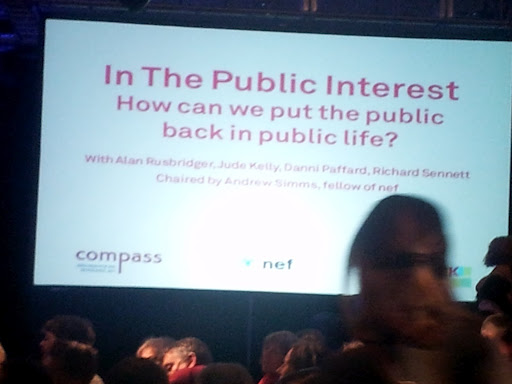
In the Public Interest: How can we put the public back into public life?


Hundreds turned out at the Southbank to see Compass, the left-leaning pressure group and the New Economics Foundation, the ethical economic think tank, host a panel of eminent thinkers and a lively audience for the first of its public assemblies, where participation was actively encouraged.

Jude Kelly, Artistic Director at the Southbank Centre, Alan Rusbridger, editor of the Guardian, Richard Sennett, writer, academic and author of ‘The Fall of Public Man’ and Danni Paffard, from the fledgling economic activism group Move Your Money, all offered their assessment of where we are, what is wrong and how we might collectively improve our lot.

The Southbank Centre, a democratic space with no one front door, felt like an excellent place to discuss the lack of civic space – in both literal and metaphorical terms – but sponsorship of the building by the oil giant Shell, much like that of the Tate by disgraced BP, leaves all sustainable thinkers wanting.

The hosts were after ideas – so we got the ball rolling.

Universities should be the place for public debate as they appear to have been in the past.

Journalism of the last 10 years has failed.

Jude Kelly opened:

We are a society with taboos and nowhere to discuss them.

Congregation space. A public forum. Temples. Alain De Botton.

The future of progress.

‘Public debate’ is via political parties and the arbiter is the media.

Alan Rusbridger said:

Phone hacking has prompted a big look into press ethics and standards.

In July, when the scandal kicked off, we were within two days of letting News Corp, that has ‘squatted over public life’, double in size. It involved everyone, from politics to the police. Common sense. Unanimous opposition. And still nothing in law.

There is now an open public interest debate about regulation, privacy, libel and subterfuge.

What is the public interest? Tabloids are commercial organisations.Solidarity means being serious about the public interest. Do not just pay lip service.

Who decides the public interest? Leveson – where is the public voice?

The Scott Trust, owners of the Guardian, allowed them to produce the story.In 17 years as editor, they only made money in 12. Now none are making money. Conventional commercial terms do not value the public interest.

Local newspapers are going out of business. Plurality?

New forms are media are where public interest journalism can occur.

Danni Paffard said:

The public needs to take more of an interest in itself. How do we make banking better? Where is the public accountability? UK Uncut has highlighted tax avoidance versus public sector cuts. £95billion in tax avoidance per year. Banking receives £100billion in subsidies.

Your bank card is so against everything you stand for. ‘You have all my money’.

We have to engage ourselves. Ethical consumerism in the banking sector. Active economic citizens. Understanding. ‘This is the new fair trade’. The ‘campaign of our time’.

In the US in October 650,000 people closed their bank accounts and put the money into credit unions.

Richard Sennett said:

Chair:

The leader of the opposition is not Ed, but Occupy.

‘Feral elite’ coined by Neal Lawson and made famous by the Guardian.

Neal Lawson said:

Believe in utopia. This is not our utopia. It is a world of private, individual selfishness and greed. Be a visionary. With the elite, there are no feedback loops.

Our minds are privatised.

Utopian good society. Public and social. It will not happen quickly. Protest, struggle and democracy.

The floor:

The notion of the ‘Public Good’ was written out of legislation in 2004. And in the US in 2005.

Coffee houses of the street. Encourage people into the street.

Public libraries.

At the end of March, it will be the end of the public health service. And the BBC certainly isn’t. LINK.

Google and Facebook are big corporations dealing in online data. We can take control.

Free schools and academies are privatisation. The data is skewed. It will privatise and centralise our school system. It will teach Latin and Churchill – of the markets and the right wing.

People who believe in markets are cultists. It is not rational. Market fundamentalists.

Nationwide would rather lend to buy-to-lets than first time buyers.

The Labour Party have been given it on a plate and they are hopeless.

Lord Philip Green doesn’t pay any tax and his money is in a bank account in the name of his Monaco wife.

‘Transform capital management’, ‘economic foodchain theory’. Incentivise business to be more of the solution than the problem.

Legal public spaces are constricted. Go where you don’t belong. How do you get people talking? Street party. Discourse. Inability to voice concerns. Anybody can have a voice. We have a right to gather and talk. Go to where you live and start the act of thinking.

We have to be good.

Vote Occupy London in the mayoral election.

Trade unionism is currently being attacked by the government. The tax payer is having to pay for them to exist within public institution. They protect the rights of taxpayers. The Guardian in 90% National Union of Journalists.

Renationalise industry.

Speak to our neighbours and go from there.

Pop-up Southbank assemblies all over London? Local campaigns. Collaborative consumption in your area. What can we do with the space lost to City roofs?

Defend the public sphere and build a better one.