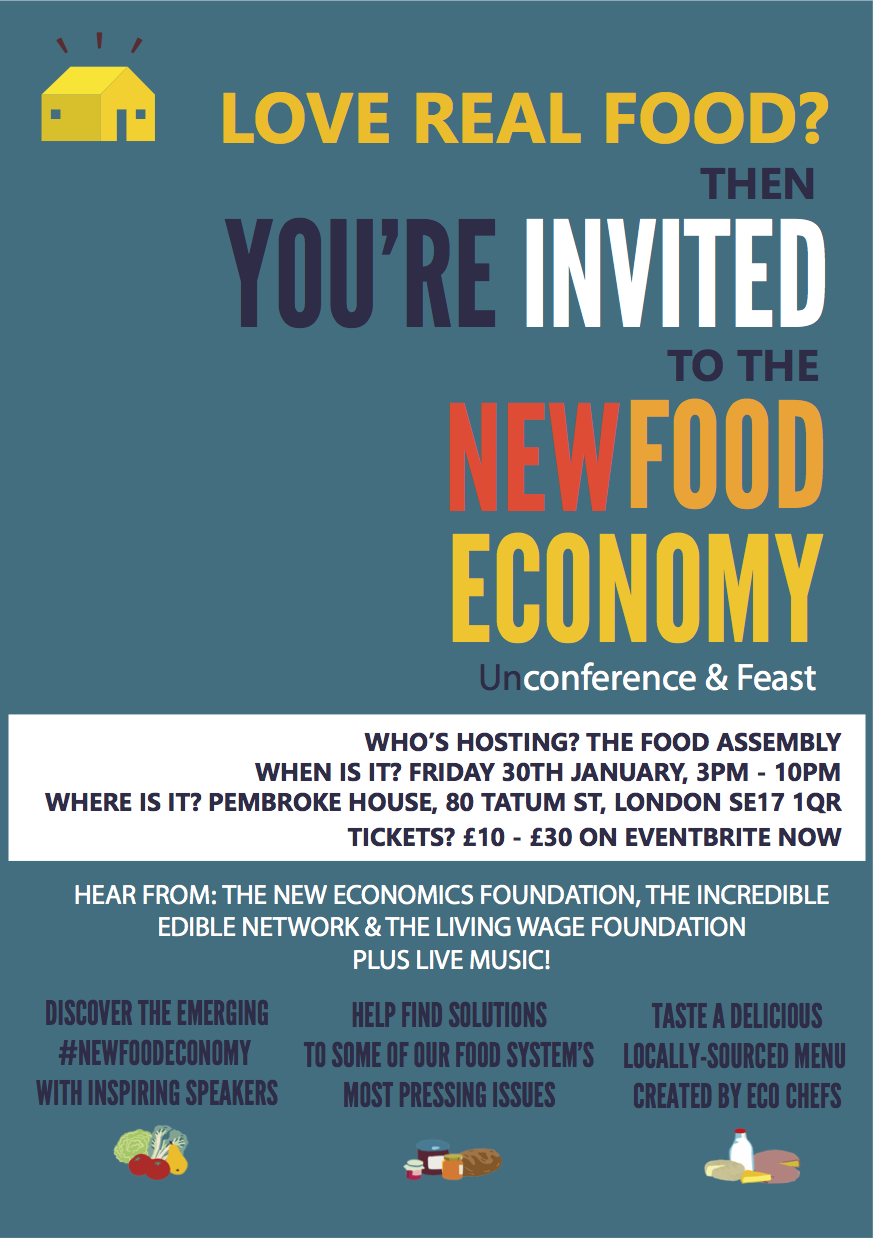
Poster and Facebook cover image created for the Food Assembly‘s January event.


Written for Tech City News and published here.
I headed home for Christmas a semi-willing participant in the ‘sharing economy’, having booked a car ride with a (thankfully non-murderous) stranger I found online. That’s what Christmas is about after all. Sharing, that is, not worrying about getting killed by people from the internet.
The trip cost me just £15, a steal compared to the £80 ticket for the train, plus it means I’m offering a small contribution to the environment by sharing the emissions, and making a new friend!
Sounds great, right?
Of course, it seems a bit strange that my earnings don’t make it that easy to take public transport, something we’re all paying for via taxation, which is perhaps the biggest unsung hero of our great global sharing experiment. But then, much public transport isn’t really public anymore.
It’s handy that a tech solution is here to step in and connect me with someone who has spare capacity, allowing them to make a little extra cash from their stuff. But, wait, isn’t sharing a not-for-profit activity?
Ridesharing is just one aspect of what we now dubiously call the ‘sharing economy’, along with everything from peer-to-peer lending and crowdfunding, online staffing, peer-to-peer accommodation, and music and video streaming.
Peer-to-peer lending and crowdfunding look set to see the largest growth between 2013 and 2025,according to the world’s accountants PwC, growing by an average 65% over this period. Based on search volume too, Google has already declared 2014 a “big year” for crowdfunding, with 21-times more searches performed this year than in 2013.
On the surface, crowdfunding, much like the other areas of this tech-enabled evolution, has all the hallmarks of “people power… [that] has the possibility of transforming the world for the better”, as Douglas Atkin from AirBnB explained on the launch of Peers, a ‘grassroots organisation that supports the sharing economy movement’. That’s an organisation incidentally backed to the hilt byevery US company that has an interest in ensuring that sharing pays.
Just this year, and in the UK alone, the wisdom and wallets of the crowd have brought FC United of Manchester to life, in a £51,000 bid to rival the might of corporatised football. They have also saved one of London’s vital inner-city farms, funded the build of a new public toilet in Worthing, and are now even being used by the UK’s only Green MP to raise election funds outside of trade unions and the private sector.
“2014 was the year that crowdfunding went mainstream in the UK,” agrees Phil Geraghty, MD of Nesta-backed crowdfunding platform Crowdfunder:
“Thousands of grassroots British ideas are becoming reality thanks to the people of the UK.”
However, beyond these projects for public good, many of which should arguably be funded by our increasingly shallow, but nonetheless shared public purse, doesn’t Kickstarter-style ‘sharing’ stink a bit of socialising the costs and privatising the profits?
Kickstarter’s formation comes with a pleasant enough story, but it’s founders have now made a handsome $42m (from 2009 to mid-2014) off the back of others’ generosity. And one of the platform’s greatest success stories, Oculus Rift, got off the ground using $2.4m of public excitement and goodwill, only to be sold to Facebook this year for a ‘wouldn’t that be great if we all shared it?’ $2bn.
If not entirely a marketing tool for a product that could have been self-funded or found funding elsewhere, some of these platforms now appear merely to act as a pre-sales outlet.
The question for backers is not ‘can I make this happen?’, or about enabling others to access something truly life-changing, but is just about snapping up early access to more goods you almost certainly don’t need. And getting your hands on those tasty ‘rewards’ not typically associated with random acts of kindness.
While crowdfunding looks like an exercise in democratising access to cash, most entrepreneurs still come from affluent backgrounds, which inevitably mean networks brimming with readily-available money should you run into trouble, ensuring greater chance of business survival. And it’s the verytax-avoiding tactics adopted by high-tech companies invested in the sharing economy – Google Ventures in Uber, Amazon’s Jeff Bezos in Airbnb – that deprive the national budget of much-needed funds.
This then perversely creates at least some need for crowdfunding campaigns – to save public services and community organisations – representing an optional extra tax on the public.
Some progressive thinkers, many of whom are sceptical about the benefits that Big Sharing from the likes of Uber and Airbnb is bringing anyone but shareholders, believe that the sharing economy movement has to get political.
By this, Rajesh Makwana, executive director of Share The World’s Resources, means “guarding against the co-optation of sharing by the corporate sector, while joining forces with a much larger body of activists that have long been calling – either explicitly or implicitly – for more transformative and fundamental forms of economic sharing across the world.”
While california-based sharing economy lawyer Janelle Orsi firmly advocates that companies in this area must be setup as cooperatives, writer Marjorie Kelly believes that there are a range of ‘for good’ models appropriate for this new economy.
Yes, I may just be becoming a little weary with ‘amazing tech crowdfund campaigns’ hitting my inbox trying to take people’s cash for things that the world definitely doesn’t need. But in the tech sector particularly, we have the skills, money, influence and, arguably, underlying intention, to make the world a better place.
Shouldn’t what we have learned to date, the platforms and underlying principles, be shared for the international common good, to address some of the biggest challenges facing our shared planet?
Or perhaps you just want to launch another taxi app?
Written for Tech City News and published here.
If you’ve worked in mobile, you’ll remember that 2011, 2012 and 2013 were all ‘the year of mobile’, and with no jargon regulators to police what that meant, the declaration was met with nods, scowls or disbelief.
As well as being crowned the year of the selfie by Twitter, and the year of gluttony by CNBC, 2014 has yet again seen impressive highs among mobile’s key metrics. But is it finally, finally the year of mobile..?
UK smartphone ownership is set to reach 80% post-Christmas, with a ‘saturation point’ of around 90% expected in 2016. The Internet Advertising Bureau reckons tablet penetration will tip 50% by the end of 2014, true validation for the device you never knew you needed.
Google’s Android platform continues to power more than 80% of the world’s smartphones and although Samsung remains the top manufacturer, its share of the market dropped from 32.1% in Q3 last year to 24.4% in 2014.
Apple’s share grew from 12.1% to 12.7%, with the remaining top five smartphone makers now all based in China: Huawei, Xiaomi and Lenovo. Record sales in emerging markets are now offsetting decline in Europe.
Mobile traffic has been threatening to overtake desktop since mid-2013, and, in Q2 and Q3, smartphone and tablet surfing on UK retail sites represented more than 50% of total traffic in two consecutive quarters for the first time.
Gartner forecast last year that the value of mobile payments worldwide would reach $235.4bn (£150.7bn) in 2013, representing a 44% increase on 2012’s $163.1bn. 37% of online sales in Q3 this year in the UK were made on mobile, 80% of which were done on tablets, with that figure reaching 43% in fashion retail. That’s growth of 4000% from the 1% made in 2010.
Gartner downgraded its prediction for contactless mobile payments “due to disappointing adoption… in all markets in 2012 and the fact that some high-profile services, such as Google Wallet and Isis, are struggling to gain traction”.
But the launch of Apple Pay in September looks set to take the service mainstream, with main rival Samsung now rumoured to be kick-starting its own version.
Given the lucrative position that owning both online and offline payments data offers, rivals are soldiering on in the US, including the big retailers with CurrentC, and the mobile operators’ effort, Softcard. However, news that the Weve payments solution, part of the JV between UK mobile operators, was being shelved back in September can’t inspire much confidence.
In its report on the opportunity of the so-called ‘sharing’ economy, PwC predicts that its value will grow from $15bn in 2013 to $335bn by 2025, equalling the revenue of traditional services like hotels and car rental.
Car sharing has been the biggest battleground in London, with the likes of Kabee, Hailo and new kid on the block, Maaxi, launched in October by Nat of the Rothschild banking dynasty, all fighting it out. This is all only slightly baffling given the range of other transport options in the capital!
Two major hurdles the report identifies, regulatory and scaling up, have both been poorly-cleared by 2014’s poster kids of sharing – Airbnb and Uber. Airbnb, which has ramped up its mobile efforts this year, has seen its users pinpointed, with up to 75% of listings in the city declared illegal.
In spite of it picking up terrible headlines in the past few months, Uber is now making its transition from being a noun to a verb, a sure sign it’s ubering its way to success, and the word is being usedleft, right and centre to describe Uber-like services in other sectors. As of December, it was available in 53 countries and, demonstrating there’s big money in, er, sharing, its latest round of funding, of $1.2bn, valued the company at more than $40bn.
Instagram just reached 300m users, overtaking Twitter’s 280m, proving that people do want to know exactly what other people had for breakfast, but now mainly in visual form. Instagram’s $1bn price, paid by Facebook for the image sharing platform and just 13 staff back in 2012, looks to have been a shrewd buy. Commentators are anticipating that it will make $100m per quarter, particularly after signing a $40m deal with Omnicom in March.
Facebook’s $18bn acquisition of WhatsApp in February has so far proved fruitless, with the company posting $15.9m in revenue, along with a loss of $232.5m, most of which went on paying share-based compensation. But Mark Zuckerberg and WhatsApp CEO Jan Koum are said to still be focused on building on its existing 600m userbase before they monetise.
According to Ofcom back in April, two-thirds of apps downloaded in the UK are never actually used, with only 10% seeing regular usage. This is reflected across developed markets and may be part of the reason that Angry Birds maker Rovio has cut 14% of its workforce and Mind Candy saw revenue drop by a third during 2013. Both combine in-app purchases and ads, a business model that may well be unsustainable.
In contrast, music and video streaming services are booming, with YouTube the latest to announce it will be offering an ad-free, £9.99-per-month subscription service.
Display ads are on the up, largely driven by video, native and rich media. Without a banner in sight, in Q3, Facebook’s mobile ad sales represented 66% of its $2.96bn ad sales, or around $1.95bn. At the same time a year earlier, mobile ads were 49% of its ad business, demonstrating the social giant’s successful transition to being mobile-first. Overall in mobile ads, search, aka Google, remains the dominant segment, representing 48.9% of total global mobile ad revenue in 2013, at $9.5bn.
To many, the death of the Nokia brand back in April symbolised the end of engineering excellence in Europe. And soon after making the acquisition, Microsoft announced 18,000 job cuts, 14% of its workforce, the majority of which were in its new hardware division.
Having cut almost 40% of its staff late last year and losing nearly $1bn, BlackBerry is seeing if a touch of nostalgia will alter its fortunes after it has sold out on pre-orders of its new, Classic handset. IBM, Dell, Sony and Philips have all likewise made huge hardware redundancies.
So 2014 was certainly a year of highs and lows for mobile; margins in hardware are clearly getting slimmer, but it’s not clear whether software businesses can generate equivalent value. The battle for 2015’s mobile tech profits will surely be fought in the cloud, particularly in enterprise, with the IoT, ‘sharing’ companies and those focused on emerging markets all tipped to win big.
Written for the Food Assembly.
Innovation charity Nesta’s 2014 New Radicals list showcases 50 of the most innovative charitable or commercial ideas the world has to offer. The food and agriculture category has doubled since the list was first compiled, from three in 2013 to six in 2014, giving a growing sense that the new food economy is well and truly here. But the kinds of new thinking seen below also give some inkling of just where and how the gaps left by public sector cuts might be filled.
Bio-bean
Bio-bean is the newest company to make Nesta’s list, founded just one year ago in London, and is looking to make something of the 200,000 tonnes of waste coffee grounds produced annually in the capital. Graduate co-founders Benjamin Harriman and Arthur Kay have already turned more than 30,000 tonnes of it into fuel, “helping to prevent emissions of methane, carbon dioxide and carbon monoxide” and are hoping to export the idea to coffee-guzzlers in the US and Europe.
Mazí Mas
Mazí Mas puts a socially responsible twist on the trend for pop-up dining in London by employing migrant and refugee women to come and cook food from their communities. Founder Nikandre Kopcke was inspired by her godmother back in 2012 to set up the social enterprise after seeing her efforts to help migrant women skill up. There are currently six female chefs who have made it from as far away as Brazil, Ethiopia and the Philippines to serve specialist dishes to sell-out crowds.
The Super Kitchen
Unemployed single mum Marsha Smith wanted to provide a communal space for families in her home city, Nottingham, to have a cheap and healthy meal: and with just £1,000, the Super Kitchen got cooking. Marsha’s social eating model, which has so far used six tonnes of food headed for landfill, has taken her on to present a TED Talk.
Box Chicken
Fast-food shops are the love of many children’s lives but the bane of many parents’, and with little power to prevent them from opening near schools, community venture Box Chicken has stepped in to provide a healthier option. Giving it her seal of approval, Fiona Godlee, editor in chief of the British Medical Journal, says: “Rather than restricting takeaway food we should seek to transform it, by making healthy food as visible, tasty, and cheap as unhealthy food.”
Casserole Club
Given that ‘meals on wheels’ provision has dropped by 63% in England, there will be ever-greater demand for social enterprises like the Casserole Club. The organisation aims to connect great cooks with lonely or vulnerable people who need a meal; 80 per cent of its diners to date have been over the age of 80. It costs around £4.90 for councils to provide a meal, so if 100 diners get on average two meals a week from a neighbour, Casserole Club will have saved councils at least £50,960 a year. The service is now coming to Tower Hamlets, Barnet and Staffordshire.
It may feel like an age since Ed Snowden made his revelations about US and UK Government spying last year, but the issue of balancing security and privacy continues largely unresolved. Now, a film documenting the NSA contractor’s first interviews with journalists, CITIZENFOUR, has hit UK cinemas, and GCHQ has a new head who says tech companies are facilitating terrorism. A perfect time to take another look at data security in the industry…. (first published in the June issue of Mobile Marketing, republished here)
Guardian editor Alan Rusbridger has called indiscriminate smartphone tracking “the biggest debate of the 21st century”, while Chi Onwurah MP, former head of telecoms technology at Ofcom and now leader of Labour’s digital government review, told Mobile Marketing that “mobile is the next big security scandal waiting to happen”.
The American Civil Liberties Union (ACLU) is currently suing the US government for its role in mass surveillance, as well as advocating a Fair Data equivalent to the Fair Trade mark for companies. Speaking at an event staged by The Economist earlier in the year, Christopher Soghoian from the ACLU levelled blame at the ad execs who built the big data marketing systems now proven to be a key tool for US and UK spies. “I’m not here to tell you what you’ve done is evil,” he told the audience. “But it is.” And with the EU and US currently reconsidering data protection legislation, the landscape is set to change quite significantly.
“People’s understanding of what can be gathered from mobiles has improved quite a lot over the last few years,” says Forrester analyst Anthony Mullen. “Data security is now the number two concern for smartphone owners according to TRUSTe – second, of course, to battery life.” It’s the range of data generated by smartphones compared to desktop, he says, that has had companies rubbing their hands but consumers wringing theirs.
Even young people, often perceived as indifferent, are becoming increasingly worried. Research from youth marketing specialists Voxburner found that 67 per cent of 16-to-24 year olds consider security their number one concern when buying an internet-connected device. But Luke Mitchell, head of insight at Voxburner, says: “Yes, young people are aware of data privacy issues and are concerned about the misuse of their data, but there is also a sense of acceptance and powerlessness among them.”
“When WhatsApp was bought by Facebook it was making no serious revenue, so the purchase price indicated that the social network was buying the OTT messaging service based on the value of each user,” says McAfee’s Raj Samani. “That works out at about $40 each, compared to around $30 when it bought Instagram and $20 when Google purchased YouTube.” The value of personal data is increasing, Samani says, but the perceived value among ordinary people is actually decreasing. “We’ve actually seen people give away their personal data for chocolate.”
Put simply, Forrester’s Mullen believes that: “Privacy policies have to be written so a grandmother could understand them. Brands should not be scared of asking for lots of data, but obviously if they don’t get data handling right, that will hinder growth. Third parties basically don’t care. From the conversations I have, it’s clear they’re just not getting it. So brands have to put pressure on them. Future mobile services need to move to prediction but brands have to be clear and transparent about who they’re sharing with.”
Privacy is the new green
Aurelie Pols has been working in data analytics for a decade and sold her first startup to what is now Digitas LBi. She now works out of Spain, which has handed out 80 per cent of the EU’s total data protection fines to date, where she leads an analytics company and specialist law firm Mind Your Privacy. If data is the new oil, Pols declared during a recent webinar with CoolaData, then privacy is the new green.
“Certain industries, like advertising, have this weird sensation that giving customers choices will make them lose money,” she told Mobile Marketing. “That’s not really the case. And the industry doesn’t seem to know how to ask for consent: ‘No let’s not ask them, let’s just take the data and say nothing’.”
More so than simply not knowing how to ask for permission, Forrester’s Mullen says that those in the industry, particularly ad networks, “have their fingers in their ears”. “Ad networks are invested in capturing a lot of local data, often employing obtuse ways of finding out what consumer identities are. Marketers and vendors will just capture as much as they possibly can and work out what to do with it later. There needs to be better planning on data need and for who capturing and measuring data is going to benefit. App developers are likewise being greedy and capturing as much as they can.”
“There is an issue with third-parties in the supply chain and the obvious one is advertising where there’s a mesh of different data flows going on,” echoes Simon Rice, group manager for technology at the Information Commissioner’s Office (ICO). “When you click on a URL, so many things are going on in the background to make the decision on which ad to serve – and you can’t predict at present where that data will go.”
The ACLU’s Christopher Soghoian flagged data brokers as a potential loose cog in the big data machine, naming the likes of Acxiom, which works with everyone from Google to Microsoft to tie up in-store and digital purchasing data. “You quickly run into organisations that don’t have a brand that can be damaged. If a third-party misuses or loses data – who will be held accountable?”
Acxiom now runs a service that enables users to find out what data it holds on them (aboutthedata.com). You just have to enter a whole load of personal details to get started… Needless to say Acxiom CEO Scott Howe favours self-regulation and brands the US Rockefeller data bill currently going through Congress as worse than the worst parts of Obamacare.
Heartbleed
The high-profile ‘Heartbleed’ security flaw found in April could have allowed hackers to access passwords and other supposedly encrypted data. The ICO’s Simon Rice says those targeting it would have had to be very lucky to get anything other than “a big blob of data”, but nevertheless, this was a serious hole in the open source code Open SSL used by everyone from Google, Amazon and Rackspace to secure their vast infrastructure.
As a not-for-profit project with only one full-time employee, the Open SSL team has successfully lobbied the big companies that use its software to contribute to its future success. Rice doesn’t advocate closed networks, with everyone from the FT to the BBC advocating open source, he simply asks: “Should companies have done a bit more code review from an organisational perspective?”
The industry’s attention has now turned to encryption as the ‘sure-fire’ way to protect data. Forrester’s Anthony Mullen says that they’re expecting to see more encryption tools – possibly even something from smartphone OS owners who were annoyed at how their data was being commandeered by security services. “It’s quite a lid that’s been lifted and it’s good for the health of the web,” he adds.
“The maths for encryption works,” Rice agrees. “The problem is it’s got to be implemented properly. If the data is secure in transit but then stored in plain text at the other end, the encryption was bullet proof – but the implementation wasn’t. My concern on the app side of things is that any app developer could just grab a code library from somewhere online, with no idea where the code came from and no due diligence process that they can explain to the user.”
McAfee says it now finds 39,000 new malware threats every single day, housing more than 40m of them in its purpose-built ‘zoo’. The data revolution in many ways, Raj Samani says, has been led by those offering ‘Hacking as a Service’, and the opportunity to rent malware or find it open source and learn how to use it by watching videos on YouTube. If robbing banks was high risk with potentially no reward, the gravitation towards cyber criminality is, arguably, just good business sense.
Data first
So what if your company is built solely on the use of data? The recently launched Cloze app has been developed specifically to help professionals manage the “novel a day” of social information they now receive as part of modern working life. Users sacrifice their personal information in order for Cloze’s algorithm to prioritise all the messages coming into their various inboxes and streams, with a premium service that adds extra features.
The company’s co-founder Alex Cote says accessing customer data is the “nature of the beast”, but as companies have been criticised for storing personally identifiable information in plain text, he explains how Cloze has been built with security and privacy baked in. “The team has built Cloze so that data is encrypted in our database so even employees can’t access it. Cloze doesn’t share any details across different users’ accounts and our security pledge, found easily on the company website, explains that data will not be sold or shared with advertisers.”
It’s not just startups that are making huge efforts to collect and analyse customer data in order to engage users, upsell services and attract advertisers. “Data is at the heart of the FT‘s strategy,” says Kristina Eriksson, head of media relations at the FT. “It gives us a deeper understanding of our audience and facilitates smarter product development and marketing.”
The FT famously shunned a presence in Apple’s App Store in order to have full visibility and control over customer data. “Because our mobile app is web-based, we are able to apply the same analytics as on desktop to campaigns on this platform, on- and offline, unlike pure ‘native’ offerings,” Eriksson says. This strategy doesn’t seem to have hurt, with mobile accounting for nearly a quarter of all new subscriptions and overall digital subscriptions to FT.com growing 31 per cent during 2013 to represent almost two-thirds of the publisher’s total paying audience.
“Our focus is on using engagement data intelligently to correlate the amount of time a brand message is exposed to our audience with the outcomes of the campaign. By matching a client’s content to FT articles through FT Smart Match we can improve campaign performance significantly.” Eriksson says that the FT works hard to ensure data protection is built into its products from the start and the company collaborates closely with technology and network providers to address any potential risks. No individual data is available internally, she adds, with analysis only made around general demographic cohorts.
Inrix, a big data analytics company working on building a huge ‘population analytics’ platform, is currently partnering with Havas on a smart city project in Oxford – a brief that seems somewhat out of the usual territory for a media agency. The project has been devised by Havas’ new chief data officer Mike Potts, who became the company’s first ever CDO back in February. He says he was appointed “to send a message to the market that we’re really serious about this”.
Matt Simmons, director of marketing for EMEA at Inrix, believes that data analysis is crucial to 21st century business. “Big data and the analysis of that data is also a catalyst for creating new and innovative services that can provide real value across a number of sectors,” he says. “Companies that use data to deliver better insights to customers and decision-makers stand a greater chance of differentiating themselves from competitors and driving their business forward in this technology-driven age.”
No Data?
Far from the smart use of data helping good companies distinguish themselves from the rest, some in the industry now believe that a full-blown ‘no data’ policy could start to be the true differentiator, identified as a trend to watch for 2014 by TrendWatching.com. “Brands will have to walk a fine line between offering consumers a valuable (and ideally seamless) service, and freaking them out with aggressive if not downright scary ‘services’. Yes, consumers want to feel served, but they don’t like to be watched.”
“Online services are actually starting to use privacy to promote their brand,” the ICO’s Rice flags. “Microsoft has just announced that they won’t do any targeted advertising for education products – now Google says they will do the same thing.” Pols welcomes this, adding: “I hope this means that in the future it’s going to be a more egalitarian battle than what it is now. I’d actually like services to allow me to pay but they say ‘this is not our business model’. This ‘free economy’ gives people no choice. You should be able to pay for stuff to keep your data private.”
Data legislation
In a landmark decision, the EU has now ruled that Google users have the ‘right to be forgotten’, with the search engine now facing an administrative task of truly unknown complexity and scale to adhere to this. Short of having a full Digital Magna Carta, something father of the internet Tim Berners-Lee demanded on the 25th anniversary of his invention, Europe has already begun the long process of revising its entire 1995 Data Protection Directive.
This is already tabled to include a more wide-ranging ‘right to be forgotten’ and while most of our commentators believe the new believe the new rules are going to be a positive thing, McAfee’s Samani says that any legislation brought in to protect citizens, and brands, from the threat of data loss, has to be realistic. “The ‘right to be forgotten’ is technically impossible. You have a digital tattoo once your data goes out there and once your data’s gone it’s gone.”
Pols believes that given that data is transferred from one continent to another at the click of a mouse, the only way to move forwards is to have global data legislation.“The US and UK get stuck with the word ‘privacy’ and as long as we find it difficult to define privacy, we can’t legislate for it. Data protection, favoured in the rest of the EU, is something totally different. Internationally, in the last six months alone, it feels like the Americans are starting to align with this. It’s certainly better than two years ago where in the US the attitude was ‘privacy is dead, just get over it’.”
“Europe’s going to lead this – spurred by legislation and informed by the continent’s recent history of fascism – and completely redrawing engagement lines between brands and consumers,” Anthony Mullen from Forrester adds. “And the press will have a field day when the flood gates open – way more than the EU cookie law. There will be a lot of pressure from journalists to get brands to change their behaviour.”
My Data?
The Boston Consulting Group (BSG) has estimated that the personal data economy could be worth €1trn (£820bn) in Europe by 2020, roughly 8 per cent of the combined GDP of the EU-27 countries. “For European businesses and governments, the use of personal data will deliver an annual benefit of €330bn by 2020, bringing growth to an otherwise stagnant economy,” a BSG report says. In its survey of 10,000 people worldwide, 78 per cent said they would use tools to control personal data if available. “Companies that excel at creating trust should be able to increase the amount of consumer data they can access by at least five to 10 times.”
Given the value now placed on data, some are now working towards offering citizens a way to actively sell this ‘new asset type’ and reap the revenue rewards themselves. Companies like Handshakes and Datacoup have begun to offer this on their own data marketplaces, but personal data on its own, as opposed to within a group of people ‘like’ you, appears to offer little value. The FT’s interactive tool ‘how much is your data personal data worth?’ explains that data brokers already know your age, gender, postcode, ethnicity and education level, all worth a sum total $0.007. If you casually throw in that you’re a millionaire, that figure only goes up to $0.123.
Some individuals are now testing the power that the internet has over your data. Internet activist Shawn Buckles sold all of his personal records for €288 in a bid to highlight data security issues. He states on his website: “Privacy is gone. We gave it up, for no other reason but the thought that it’s useless. Why don’t we protect our rights?” Buckles was quickly followed on this mission by mum-to-be Janet Vertesi, who went to extreme lengths to hide her pregnancy from big data and was flagged as a criminal along the way.
The UK Government’s own Midata project is also working on ways for citizens to access their data for use for civic services. “The Midata programme is a voluntary programme working with companies in key sectors of the economy: energy, personal current accounts, debit cards and credit cards,” says Gemma Lobb from the Department for Business Innovation and Skills, which is backing the work. “The Government is focusing on areas where the data held will have the most value for consumers, either in terms of giving them access to the type of information that will help them make an effective switching choice, or where there is the potential for the data to drive services to empower them.”
People will eventually be able to download a transcript of their data and use it as part of the personal data economy, which is great if you trust the Government to help you manage your personal details. According to BCG, government is less trusted than brands on data management. The Midata programme itself does not have access to any data, Lobb explained, it’s working with brands so that they are encouraged to give back certain data that they hold on their customers. The team recently set up a consumer protection and trust work stream that is soon to report on its findings. “I worry about how we educate individuals of what are the additional risks are around giving people a full transcript in readable format of their personal data,” admits the ICO’s Rice. “Scammers and spammers will be onto this as well.”
The Government has wholeheartedly joined the open data revolution, even giving £10m grant funding to London’s Open Data Institute, but questions remain around what political involvement does to the neutrality of data collection and dissemination. Plans to sell off NHS data have been “mishandled”, according to the chair of the panel set up to advise the NHS and ministers on the governance of patient information, while HMRC’s plan to sell of its data has been branded “borderline insane” by Conservative MP David Davis.
Trust
Although a complex area, it appears that words like transparency and consent are now coming into everyday vocabulary for marketers, policymakers and citizens, with seductive opportunities to collect data becoming increasingly heavily weighed against the potential to leave people feeling betrayed.
“Phase one was all about snooping – which was a great advantage for advertisers,” Forrester’s Mullen concludes. “In phase two we’re seeing more awareness and more controls. But we need to go through this to realign. Phase three will see much more automation, around wearables and contextual services, when people trust brands to do this for them. The nirvana of deeper, richer services will not come until we go through this pain.
“Privacy really is just a subset of this bigger topic – trust,” he adds. Trust is a much more positive thing to hang this change in the way that we use data on and I want to see this reframed as the trust debate.”
So it looks like we are in a transition. But we – people, government and business – are yet to really start talking to each other about, and truly understanding the consequences of, smartphone tracking, as Guardian editor Alan Rusbridger urges, less still the complexities of a full-blown debate about trust. And without this, yet more scandals, either through intention or oversight, are no doubt on their way.
Watching CITIZENFOUR on Friday was certainly one uncomfortable way to spend Halloween. Find a screening of the film here.
There are 2,000 charities in Hackney, 90 per cent of which have an income of less than £10,000. ‘Give a day for Hackney’ is a mentoring programme that aims to support third sector organisations to identify and address their tech and business needs.
Our City is seeking developers and entrepreneurs to mentor and assist organisations to realise their potential and address their biggest challenges. Through a pitch process at Hackney Council’s first Hackneython hack day in 2014 each organisation will outline their need and will be available for a Q&A with the audience. Developers and entrepreneurs will then be invited to sign up to ‘Give a day for Hackney’ on the mentoring programme.
Mentee requirements:
Mentor requirements:
12 hours of contact time over a 3 / 6 month time period
Mentees must complete a Training Needs Analysis form. Mentors will ideally be able to dedicate 12 hours of contact time and can email hackneyunites@btinternet.com to get involved.
The Our City project has been created by Hackney Unites, the Shoreditch Trust and local volunteers to work out how local residents in Hoxton can engage with Tech City and the incoming flow of workers.

Worked as production editor for the redesign of Mobile Marketing’s print magazine. See the full issue here.

Beaming: Banister House Solar Co-Op Intern Victoria Omobuwajo. Photograph: Millie Darling
Solar panels on the roof of Homerton Grove Adventure Playground’s building have recently been repaired in a joint project by playground staff and volunteers from local community group Hackney Energy.
Volunteers from Hackney Energy and the first solar co-operative to be launched in the borough, Banister House Solar Co-op, helped repair the system – one of the first of its kind to be connected to the national grid.
The team, working with Hackney-based solar firm Athena Electrical, found it was the wiring and the inverter that had stopped working.
The inverter is crucial as it transforms the energy generated by the panels from DC electricity to AC so it can work in the national grid.
The panels were installed nearly 20 years ago by Wind and Sun and are still in good working order. The company gave the new inverter to the playground at a reduced cost in order for them to get back on the grid.
Bridget Handscombe, Play Manager for Hackney Play Association, which runs the playground on Wardle Street, said: “I’d had quotes of £6,000 to replace the inverter but we couldn’t even start to look at paying something like that.
“We fundraise so that disabled children can go swimming or to replace the play area structure, so this just wouldn’t have made it to the top of the list.”
Solar Future
Green Party MEP for London Jean Lambert attended the launch of the new solar system. She said: “”It’s fantastic to see solar power back in action at Homerton Grove Adventure Playground, and community projects in Hackney leading the way.
“Solar is the future, and co-operatives and community groups can play a big part making it happen. I hope this will inspire others to get involved with local community energy projects or set up their own.”
Cllr Jonathan McShane, Cabinet Member for Health, Social Care and Culture, also came along to the relaunch party. He tweeted:Bain
New generation
Some of the volunteers who took part in the project were young people from the Banister House Estate in Homerton currently taking part in an internship scheme organised by the Banister House Solar Co-op.
Victoria Omobuwajo, one of the Banister House interns, said: “I always knew that fossil fuels were harming the environment and think solar is a great idea.
“Working with Hackney Energy as one of the Banister interns has showed me it is possible to make solar work in the UK. A lot of people on the Banister Estate don’t really know about solar and how it’s going to benefit them – we are showing them that it can save you money and is great for the environment.
“One of my main aims is to take solar to other countries that don’t have electricity. My mum lives in Nigeria and when the only electricity provider turns the power off, she has to use a generator just so she can call me.
“Even to do simple things, like a child coming home to do their homework, is impossible without electricity. They need an alternative.”
Written for the Hackney Citizen and first published here.
A fifth of London’s electricity supply could come from solar power, according to a new report commissioned by Green London Assembly member Jenny Jones. Yet the capital has the lowest uptake of the technology of anywhere in the UK.
Perversely, London is beaten into last place by both Scotland and the North East, in spite of the fact that these areas get much less sunshine.
Just one in 260 London households has solar panels on the roof, compared to the UK leader, the South West region, where one in every 32 homes generates its own solar power.
London’s 13,000 installations could meet the annual electricity needs of 12,000 houses, while on the other side of the country, the South West’s solar panels can supply the equivalent of some 110,000 homes.
Hackney is in the bottom 10 in London for the number of solar panels per household, with just one in every 441 dwellings generating its own solar energy. Waltham Forest comes out as the clear solar star, while Tower Hamlets finishes in last place.
Solar photovoltaic (PV) cells capture the sun’s energy and convert it into electricity. They still work on a cloudy day, although the stronger the sunshine, the more energy produced.
An average system for a domestic property will set you back between £6,000 and £7,000, with the cost falling all the time, but it should generate enough electricity in a year to power a typical household.
And under the Government’s Green Deal, people that choose solar can get cash back for their investment.
So why can’t we keep up? Germany, where the climate is not dissimilar from the South of England, recently surpassed its own record of generating 50 per cent of its energy from the sun. Here, the focus has been on community, commercial and industrial installations over domestic.
The Greens argue this should be London’s focus too, just like the installation on Blackfriars Bridge that produces enough solar energy to power 333 homes all year round.
“We need a City Hall team who can visit residents in flats, community groups, or business with advice and kick-start support,” Jones says. “We need to harvest solar generated electricity from the underused and empty roof tops of London’s commercial and industrial businesses, supermarkets, car parks, schools, transport and public buildings and other spaces.”
London’s first community energy project was set up by Repowering London in Brixton, emerging from one of the ten ‘Low Carbon Zones’, which were dropped by the London Mayor in 2012.
Repowering London is now supporting Hackney Energy, the first project of this kind in the borough, which is due to go live in the
coming months.
“London has enormous potential for solar,” Millie Darling, chair of Hackney Energy, says. “On my cycles around London I look up to see rooftops all around that could play a part in powering our city.”
“London has an important role to play in leading the way in the world’s transition to renewables,” she adds.
Hackney Energy is also working with Repowering London to set up the borough’s first solar energy co-operative, planned for the Banister House estate in Homerton, whose large, flat roofs make them ideal.
The project will be funded via a community share offer, which both local residents and non-residents can invest in. All income created by the electricity generated will go back to co-operative members and into the Banister House Community Fund for energy efficiency initiatives.
Meanwhile, Jenny Jones is calling on the Mayor to develop a London-wide solar strategy, with targets in place by the end of next year.
Written for the Hackney Citizen and first published here.
Tech City may be the centre of the UK’s technology industry, but it has a serious problem with broadband.
High-speed internet is notoriously hard to come by in the former warehouse districts of East London. So hard, in fact, that Tech City’s broadband woes have been described as a “national embarrassment” by Meg Hillier, MP for Hackney South and Shoreditch.
Globally, the UK is languishing in 15th place for overall broadband speeds. Locally, thousands of homes in Hackney can’t afford a decent internet connection. If there was ever a hole in the market, this is it.
Like most who’ve set up in Tech City, Optimity has developed with disruption in mind, going head-to-head with behemoths like Virgin and BT to offer high-speed internet to the burgeoning digital community.
While fibre optic broadband provided by the big telecoms companies may be fast enough when you get it, it can take months for your chosen provider to dig up the road and lay the cables — too long for most young digital businesses to wait.
Award-winning local firm Optimity cuts out the middle man by providing high-speed wireless antennae that are fixed to the roofs of buildings, a service that can be up in a matter of days.
Its radio wave technology can run at speeds of up to one gigabit – that’s 200 times faster than regular broadband – and if there’s ever a problem with it, an engineer will simply walk around to the office and switch the box.
The company is a resident in one of Shoreditch’s most striking buildings, Zetland House, the 100,000-square-foot former home to the print works for the Bank of England.
Optimity provides wireless broadband exclusively to London businesses, which means no three-month wait to get started and no dealing with far-flung call centres.
“Demand for high-speed is growing very quickly, full stop,” says founder of Optimity Anthony Impey. “iPads, for example, didn’t even exist pre-2010 and four years is an incredibly fast period to become nearly ubiquitous.
“People are also working less at home now than they were, opting to work side-by-side at local coffee shops and co-working spaces. So there are a huge number of businesses in the area that just need faster and faster internet.”
Global competition
Former Mayor of New York Michael Bloomberg has said London is the number one competitor to his city in the technology race. But Impey goes so far as to whittle that down to New York versus Hackney: “This is the heart of the whole digital community. The focus on building infrastructure in Hackney is crucial to London’s leadership as a tech capital.”
At the moment, Optimity serves some 250 local businesses, with the area between Shoreditch and the Olympic Park its key target. Business users can pay around £500 to £600 per month for high-speed broadband, but with its low installation costs, Optimity can cut that cost by about a tenth. The radio spectrum used by Optimity is a low-power, high-performance system originally released by the Ministry of Defence.
The company’s mid-size antenna is just 120mm square, smaller than a satellite dish, and has a tiny footprint compared to a mobile phone mast. Over time this will become even smaller and cost even less, hopefully allowing for the technology to be passed on to residential users — a threatening prospect for the clunky status quo of web providers.
‘David and Goliath’ battle
Impey says that the great digital revolution took the older telecoms companies by surprise and he believes they have made a notable lack of investment at the exact time when London needs it most. “How do we become a gigabit city?” he ponders, referring to the uppermost upload and download speeds made possible with today’s technology. “We need infrastructure that can meet the demand of the tech companies not just today, but in three, five and 10 years’ time.”
The CEO paints his company’s story as a ‘David and Goliath’ fight. “Our competitors are so much more significant and have almost limitless resources… We deliver a very good product, underpinned by an amazing service.”
Just like many companies operating in Tech City, Optimity did not set out to become what it is today, a wireless internet service provider (WISP). The company used to simply offer IT and telecoms services but took the opportunity to ‘pivot’, as the techies call it, when a client needed high-speed broadband, fast.
But, having worked in computing in Hackney for a more than a decade they can also manage clients’ IT and telecoms services too, whether that’s a virtual server or a telephone system.
Thinking local
Optimity has won awards for its commitment to provide local jobs and its outreach work with young people. The company is a backer of Tech City Stars, which recruits young people onto apprenticeships with the help of some 380 sponsor organisations, and is training some apprentices in its office. “There is an amazing amount of untapped talent in Hackney,” Impey says.
Ali Hussain has been an apprentice at Optimity for almost a year. “I had no idea about Tech City but as I hadn’t got the grades to go to university it was another option. Recently I got to go up to the 39th floor of the Heron Tower to help install some kit and had a view of London I never thought I’d see.”
Impey is a huge supporter of the Government’s Super Connected Cities initiative, which helps businesses fund the step change in their internet connection: “This is such an important piece of infrastructure – I’d say even more important than roads and airports, even train lines”, says Impey.
“Moving data around in a digital economy is everything. If you closed down the internet network in proportion to the tube, there’d be a revolution.”
 Kirsty Styles