Written as editor of the New Statesman’s NS Tech and first published here.
The man behind the man behind UKIP, i.e., the guy who’s been bankrolling Nigel Farage’s party reasonably unnoticed, is “insurance millionaire” Arron Banks.
Just yesterday, the softly spoken party donor (particularly in contrast to Farage) quietly pledged £10 million to fund a new political party if Theresa May won the Tory leadership.
Now that’s all done – following Andrea Leadsom’s decision to leave the race, meaning May will likely be in Number 10 by Wednesday – we must quickly turn our attention back to the man who isn’t afraid to put his money where his mouth is.
Speaking to Andrew Marr on the BBC yesterday morning, Banks, who gave millions to the unofficial Leave.EU campaign said: “If Theresa May wins, UKIP will be back with a vengeance.
“We potentially could be talking about a new party and I think there are very sound reasons for that.
“The Leave.EU campaign has nearly one million online followers. On social media it reached out to 15 million people a week.”
Banks said it would have a new name and would “very much so” be an online effort, with more money and fresh faces.
He claimed Leave.EU’s email database, a goldmine to anyone doing digital campaigning, already has 40,000 Conservative members on it, of a membership only tipping 100,000.
But, as Banks admitted to Marr, “the Conservative Party is a dying membership”, so hardly the target market for a new, jazzy digital party.
There are, of course, 500,000 Labour members out there too.
Not to mention all the normal people who don’t usually join political parties, but presumably will now that they’re doing good memes.
With UKIP, or with a swanky rebranded party, Banks said he reckons they could win 30 to 40 seats next time around, likely in places in the North East that voted heavily for Leave.
“I don’t think it’s just immigration. It’s this whole disconnect between the ‘metropolitan elite’ that sneer at working people and I think there’s a great opportunity to take some real policies back into these Labour heartlands.”
He also touted the potential for more direct democracy initiatives, like the referendum.
If Leadsom had stayed in the race and won, UKIP voters could probably have been convinced to switch their support back to the mainstream party. Although, had that happened, some Conservative MPs had already pledged they would quit.
Now Leadsom is out, you could be hearing more from NuKIP (?) in your newsfeed very soon. Watch this space.
Written as editor of the New Statesman’s NS Tech and first published here.
The controversial new EU and US cross-border commercial data transfer deal Privacy Shield has passed a final vote by member states’ representatives in Europe.
Privacy Shield replaces the old Safe Harbor framework, which was struck down by the European Court of Justice after a legal challenge following Ed Snowden’s US government spying revelations.
It is intended to ensure greater privacy for Europeans whose consumer data is being processed in the US by companies like Facebook and Google.
“The EU-US Privacy Shield will ensure a high level of protection for individuals and legal certainty for business,” the European Commission’s VP for the Digital Single Market Andrus Ansip said in a statement.
“It is fundamentally different from the old ‘Safe Harbour’. It imposes clear and strong obligations on companies handling the data and makes sure that these rules are followed and enforced in practice.
“For the first time, the US has given the EU written assurance that the access of public authorities for law enforcement and national security will be subject to clear limitations, safeguards and oversight mechanisms and has ruled out indiscriminate mass surveillance of European citizens’ data.
The new deal was rejected in its current form by the EU’s data protection group Article 29 for being “complex” and “unclear”. There were four countries that abstained on this latest vote too, Austria, Slovenia, Croatia and Bulgaria.
But that doesn’t matter now, it is set to be fully approved by the Commission next week, then the US will sign it.
At least this ends months of uncertainty for business, who needs privacy anyway?
Written as editor of the New Statesman’s NS Tech and first published here.
I won a ticket to see Tony Blair give evidence at the Chilcot ‘Iraq’ Inquiry back in January 2010.
When I’d applied for the ballot, it felt like a big moment but, to be honest, I largely felt the same yesterday as I did when I saw him speaking back then.
He’s not suddenly going to change the line. He did what he thought was right. There is no conspiracy. Chilcot’s summary was pretty damning, but not exactly shocking:
The judgements about the severity of the threat posed by Iraq’s weapons of mass destruction WMD were presented with a certainty that was not justified
Despite explicit warnings, the consequences of the invasion were underestimated. The planning and preparations for Iraq after Saddam Hussein were wholly inadequate
The Government failed to achieve its stated objectives
But, from a technical perspective at least, there’s something a bit more interesting going on.
I can’t remember exactly where I met Terence, but I’ve known him for a few years and once he helped me out when I thought I’d had my identity cloned in Ukraine.
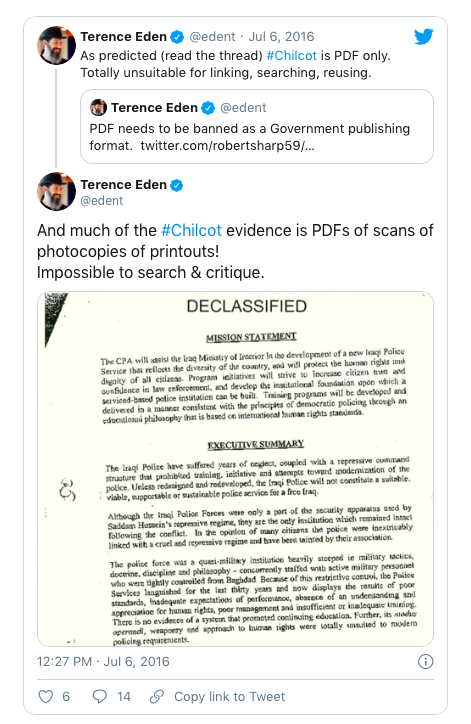
Turns out, my old mate has been working away for years on Chilcot, not only trying to convince the Inquiry to offer better access to the files, but also trying to work out how to crowdsource efforts to open up the documents.
It didn’t do a bad job, but Google Docs has an upload limit and no one in their right mind would sit and do that for all of the evidence.
And Terence’s targeted plea to Chilcot went unheard.
Fortunately, the internet has (sort of) come to the rescue, so you can at least go through the entire PDF in one go, rather than following endless links.
You can also go ahead and use the search engine on the Inquiry site – the first scanned letter that mentions George Bush is suitably sad – but you really have to know what you’re looking for if you’re doing this.
Jeni Tennison, technical director at the Open Data Institute, told NS Tech:
“It’s disappointing to see such an important and long-awaited document published as a series of PDFs.
“The historic document should have been made far more accessible to the public and clearly openly licensed, allowing them not just to read it, but to reuse its content and reference it in their own conversations.
“And the annexes, which contain useful reference maps and data, should have been published as open data to enable others to create visualisations and analyses beyond those provided by the report.
“Improving our public discourse requires us to improve how we provide access to information.”
Terence, meanwhile, has a cheeky six-point wishlist:
Publish in an open and accessible format, namely HTML
Have a PDF option for those who want to print it
Insist that all evidence is original electronic documents – not scans of photocopies of printouts (where possible)
Ensure that any scans are optical character recognised and corrected
Use a data markup scheme so that it’s easy to disambiguate data, eg. does “Kelly said that” refer to Dr David Kelly or Captain Jo Kelly
That’d do!
The referendum result proved we have a profound mistrust of experts, as well as a bunch of politicians who will wilfully present ‘data’ as ‘facts’.
Chilcot is a missed opportunity to use basic technology within the public sector to the benefit of ordinary people.
Written as editor of the New Statesman’s NS Tech and first published here.
LinkedIn’s latest Global Recruiting Trends report identifies just how far we still have to go on getting gender equality in STEM professions.
Not only do women only make up 24 per cent of new hires, as you head up the career ladder, that drops to 19 per cent among managers and 17 per cent of directors.
The STEM sector with the largest number of women is research, while the area with the lowest is engineering.
LinkedIn used data from the millions of people who use its platform, as well as surveying more than 6,500 members, to build out the picture for its latest report.
The research found that women are more likely than their male peers to be actively looking for work or thinking of leaving their current roles within a year.
Bad interactions with a boss or teammate was the top reason for this, followed by a long commute and then a “frustrating day at work”.
The culture, employees’ experiences and their work having a purpose were key reasons for both sets of workers to want to join a company – but these were all more important for women.
LinkedIn’s recruitment arm, which conducted the research, also looks in detail about the processes that companies now say they have in place to make recruitment better.
Hiring from employee recommendations continues to grow, as well as the desire to retain good staff rather than look elsewhere – but demand is far outstripping the budgets spent on finding the right people.
Written as editor of the New Statesman’s NS Tech and first published here.
The EU commission has unveiled a €1.8 billion public-private investment into cyber security research and innovation – just as the UK has begun untangling itself from its European neighbours.
“Europe needs high quality, affordable and interoperable cyber security products and services,” said Günther Oettinger, Commissioner for the Digital Economy and Society.
“We call on member states and all cyber security bodies to strengthen cooperation and pool their knowledge, information and expertise to increase Europe’s cyber resilience.”
Although the initiative has been in the works since 2013 and €450 million of funding will come directly from the existing Horizon 2020 innovation programme, it’s looking unlikely that the UK will be able to participate directly.
The cyber security industry has committed the remaining amount, via the European Cyber Security Organisation (ECSO).
The investment will seek to create common cyber security standards across key industries, including energy, health, transport and finance, as well as a new certification framework for selling solutions across the EU.
VP for the Digital Single Market Andrus Ansip said that “without trust and security, there can be no Digital Single Market”.
But without our EU membership, there isn’t great hope of full access to this trusted and secure network.
The European Parliament is also expected to sign the related Network and Information Security Directive, which is designed to create a network of Computer Security Incident Response Teams across the EU.
“It’s good to see the EU increasing funding and making cyber security a top priority and sad that, due to Brexit, UK universities and businesses will miss out on this investment,” said Kevin Bocek, chief security strategist at cyber security software firm Venafi.
He urges the EU to looking beyond “‘securing identities online”, which he believes is now outdated.
A DCMS spokesperson told NS Tech: “Government has made the cyber security agenda a top priority, allocating £1.9 billion towards it to help ensure that the UK is well placed to meet the challenges it presents.
“We will continue to work closely with our EU and other international partners on the cyber security agenda.”
Written as editor of the New Statesman’s NS Tech and first published here.
The US National Highway Traffic Safety Administration is already looking into the first fatality in a Tesla Model S car operating on Autopilot mode.
Tesla was quick to make a public statement on the death but its early words on the incident point to real, ongoing issues with our self-driving future.
“Neither Autopilot nor the driver noticed the white side of the tractor trailer against a brightly lit sky, so the brake was not applied,” the company says.
It goes on to explain:
“It is important to note that Tesla disables Autopilot by default and requires explicit acknowledgement that the system is new technology and still in a public beta phase before it can be enabled.
“When drivers activate Autopilot, the acknowledgment box explains, among other things, that Autopilot ‘is an assist feature that requires you to keep your hands on the steering wheel at all times’, and that ‘you need to maintain control and responsibility for your vehicle’ while using it.
“Additionally, every time that Autopilot is engaged, the car reminds the driver to ‘Always keep your hands on the wheel. Be prepared to take over at any time’.
“The system also makes frequent checks to ensure that the driver’s hands remain on the wheel and provides visual and audible alerts if hands-on is not detected. It then gradually slows down the car until hands-on is detected again.”
From the above, it’s difficult to distinguish who is at fault here, which is obviously not unheard of in the insurance industry.
Tesla clearly outlines the warnings it gives people before they activate Autopilot, but the system also gives ongoing reminders to keep their hands on the wheel, and even slows down if they aren’t.
Indeed, speaking recently at the Hay-on-Wye Festival, entrepreneur, CEO and author Margaret Heffernan said:
“It’s really important to understand that the prevailing wisdom within Silicon Valley is that the business model for the Internet of Things is insurance.
“As long as I can keep track of your driverless car’s movements from your phone, as long as you have a monopoly on this huge amount of data, you have the ability to manage the insurance market, to decide who gets insurance, who doesn’t.”
If this is, as Heffernan believes, the new Silicon Valley business model du jour, it’s not without real, life-changing risk.
We’ll have to wait to find out more about whether this was a failure of human or software, but this is a real tough area of law that is still yet to be fully thrashed out. If it ever really could be. Surely no company wants this kind of life or death question on their corporate conscience?
Intel took the opportunity today, of all days, to say ‘the future of autonomous driving starts today’ with its announcement that it’ll be working with BMW to bring driverless cars to the streets by 2021.
Partnerships like this raise yet further questions, who’s at fault if more than one company contributed to the making of the car?
The Association of British Insurers notes that 90 per cent of road traffic accidents are caused by human error, but in its early analysis of the potential for driverless cars states:
“As vehicles become increasingly connected with other vehicles – and as the control input transfers from human to computer, it is possible that liability will follow that transfer of risk. There is therefore the potential for the vehicle manufacturer to become liable for an accident, as opposed to the driver, if the driver is unable to override the system.
“The insurance industry is continuing to work with government, vehicle manufacturers, regulators, the legal community and through the industry’s research and repair centre, Thatcham, on this potentially life-changing and life-saving technology.”
This sad death in a Tesla vehicle will no doubt be of interest to insurers all over the world in need of a test case.
Whether you’re smartening up your office, home or transport system, the automation offered by the IoT is certainly powerful, but it also changes the nature of liability.
Written as editor of the New Statesman’s NS Tech and first published here.
Wading through the speeches made during the second reading of the Investigatory Powers Bill in the House of Lords and one thing is clear – those guys are old.
The average age of more than 40 speakers who made their cases (largely for) the controversial bill is 65, which would be the mandatory state retirement age, if we weren’t all being made to work until we’re 100.
Just 11 of the group speaking about surveillance in a digital landscape are under the age where we’d have been able to legitimately pack them off into their slippers.
The oldest person to contribute to the debate yesterday evening was Baron King of Bridgwater (83), who rather gracefully admitted: “I stand here as an avowed ignoramus on many of these amazing technologies, such as WhatsApp, Snapchat, Twitter and Facebook.”
He was first elected as an MP for the Conservative Party in 1970 and was brought into the Cabinet in 1983 by Margaret Thatcher.
The oldest woman to add her voice to the proceedings was 80-year-old Baroness Ramsay of Cartvale, who used to work at MI6.
She praised the highly criticised “bulk data” powers, presumably because in her day that meant a sack of intercepted envelopes to steam open.
Many, including some of her fellow peers, believe that collecting too much data can actually impede the spotting of criminals.
When giving evidence to the Joint Committee scrutinising the bill back in December, Internet Service Providers (ISPs) flagged no less than nine pretty profound challenges they saw with the new rules.
Youngsters
There were just two speakers in their 40s, one of whom is the only person who still has direct experience of the new rules as they might apply to ISPs; that’s Dido Harding.
Baroness Harding of Winscombe, as she’s known in the House, is the very same Baroness Harding of Winscombe who’s been heavily criticised following significant customer data breaches over at TalkTalk, where she is the CEO.
The Culture Media & Sport Committee, reporting on TalkTalk ahead of the Information Commissioner’s verdict on the incident, did not recommended she be sacked, but suggested “a portion of CEO compensation should be linked to effective cyber security”.
Instead Harding has just received a £2.8m pay packet.
And now she’s adding her expertise to what could become a personal data goldmine for hackers.
The other youngster is 46-years-young Baron Oates; that’s Jonny Oates, former chief of staff to Nick Clegg and director of policy and communications for the Liberal Democrats.
Which went well.
Of course, there is plenty of expertise in the House of Lords, including retired police officials, as well as people who served on the bill’s scrutiny committee, the Intelligence Select Committee and the Joint Committee on Human Rights.
Let’s just hope that assumptions aren’t being made on their part simply because they largely do not live digital lives.
We are, of course, still just seeing the fallout from the last time over-65s made the decision on something important…
Written as editor of the New Statesman’s NS Tech and first published here.
The petition to force parliament to debate a second EU referendum, which has smashed previous records for number of signatures, has been hijacked by bots.
Although David Cameron has officially ruled out a second vote, millions have apparently flocked to sign the petition, which claims that if the “vote is less than 60 per cent based a turnout less than 75 per cent there should be another referendum”.
Although a quick inspection of the backend reveals some pretty far flung signatories, you are able to sign the petition anywhere in the world, as long as you are a British citizen.
All you need is an email address and a postcode, and no further checks are made to confirm you are who you say you are.
The platform doesn’t even offer an ‘are you human?’ captcha tool, the most basic method to fox online bots.
The House of Commons petitions committee has now confirmed it has removed 77,000 signatures and is “investigating”.
This adds yet more silliness to what was already a ridiculous petition.
For an added loony layer, it was revealed over the weekend the campaign was actually started by someone who wanted the UK to leave.
On the security flaws in the petitioning platform, Javvad Malik, security advocate at AlienVault, said:
“Bots come in various guises and can cause damage to a website or the integrity of its data via content theft, click fraud, traffic fraud, comment (or in this case petition) spam, server slowdowns and more.
“Any public-facing website, particularly sites such as online petitions which trigger actions when a certain number of signatures have been collected should have protection in place in order to safeguard the integrity and availability of its information with anti-bot and anti-DDoS measures amongst others.
“In order to protect against all bots, companies should deploy various detection techniques and be continually kept up to date to detect bot activity as soon as possible. Having a good source of threat intelligence can help identify and block bot-traffic early.”
Who said a referendum couldn’t be fun? Thank goodness for the internet!
Written as editor of the New Statesman’s NS Tech and first published here.
The controversial Investigatory Powers Bill is due for its second reading in the House of Lords today but campaigners have urged for this to be halted in the wake of Brexit.
The Open Rights Group’s executive Director, Jim Killock, said:
“With the current political crisis, we cannot expect that such an important bill, with far-reaching consequences, will receive the scrutiny it needs. Until this crisis is resolved, and a new Prime Minister is in place, the IP Bill should be put on hold. The UK cannot legislate on matters of national security until its future is clear.”
The bill, as it stands, could take an unreasonable toll on business.
While concessions made in parliament mean that technology companies will not have to build backdoors into encryption software, judges can demand that firms create tools to help them access communications.
Public and private databases will be open to access by security services and provisions have been made for the hacking of devices of people who are not direct suspects of a crime.
Internet Service Providers will have to keep databases of things like people’s web and app browsing history, but the government says it will reimburse them for the cost of complying.
With a lot of civil rights protections written into European law, the next few months and years could be a critical moment for UK citizens’ digital rights.
Written as editor of the New Statesman’s NS Tech and first published here.
We heard this week about the UK and Europe’s unicorn companies valued at $1 billion or more, with several since 2000 achieving that all-important exit.
But today’s big exit is, of course, the UK itself as huge swathes of the country ‘ignored the experts’ and voted for Britain to leave the EU. Brexit, Britain’s dramatic exit.
Typically positioning itself as apolitical, as long as it gets freedom to grow, the tech industry from multinationals to startups largely abandoned this to come out in favour of Bremain.
The protests went unheard. So here’s what could happen next for UK tech.
Exports
James Dyson, one of few brave Brexiteers, actually argued recently that leaving would make it easier to trade beyond Europe, which is where he already sells most of his wares.
But it’s not exactly easy, if you aren’t the UK’s biggest hoover maker, to change up your export strategy.
The EU makes up almost half of all our exports right now, a full 15 per cent of our GDP, which is a huge chunk of change representing £223 billion of goods last year.
We actually buy five-times more stuff from Europe than it buys from us, which leavers think gives us a good position to negotiate. Unfortunately a greater share of our GDP relies on Europe buying from us, so… jury’s out.
Digital Single Market
The DSM is designed to harmonise the trading of digital goods and services across borders, as well as ironing out different rules for web governance. The internet is without borders, after all.
The wide-ranging plans have been criticisedalmost as much as they’ve been welcomed, but it’ll be a pain in the arse to untangle ourselves from this, only to have to plug our stupid British plug right back in again.
Data protection
One big part of the DSM is the impending General Data Protection Regulations, designed to create a single set of robust rules for the transfer of customer data.
Most companies in the UK should have already started working to implement this ahead of the 2018 deadline, so this throws a bit of a spanner in the works.
The Information Commissioner’s Office has now confirmed:
“The Data Protection Act remains the law of the land irrespective of the referendum result.
“If the UK is not part of the EU, then upcoming EU reforms to data protection law would not directly apply to the UK.
“But if the UK wants to trade with the Single Market on equal terms we would have to prove ‘adequacy’ – in other words UK data protection standards would have to be equivalent to the EU’s General Data Protection Regulation framework starting in 2018.”
For individuals, and in light of the likely passage of the highly controversial Investigatory Powers Bill in the UK, people could well be more vulnerable to government snooping.
Privacy Shield
Companies like Amazon and IBM have already got data centres based in Europe ahead of changes to transfer regulations following issues around the Safe Harbor agreement.
This might mean that companies are increasingly forced to choose mainland Europe for these data centre sites over the UK, if they haven’t already.
Any UK-based companies could also be made to host European data on EU soil, with the likes of AWS in Germany an obvious choice, unless we come to a new agreement.
Cyber crime
There have been several warnings from cyber security surveys floating around online in recent weeks.
But Trend Micro’s global VP of cyber security research, Rik Ferguson, who also sites on Europol’s internet security advisory group, told NS Tech he isn’t too worried.
“We don’t perceive it as making an concrete difference to any cooperation that happens. Europol is made up of European police forces but also works with the FSB in Russia and more widely Interpol. There’s nothing to stop it having ongoing relationships with UK police forces.”
Investment
Microsoft’s chief executive in the UK, Michel Van der Bel said in an open letter to staff last month:
“Historically, the UK being part of the EU has been one of several important criteria that make it one of the most attractive places in Europe for the range of investments we have made.”
This might well not continue depending on how things change. But so far, so bad.
Offices
Word on the grapevine is that many tech are exploring the potential for opening new offices in mainland Europe should the worst happen.
Now that it has, predictions that Google and Amazon will be among the companies that opt to halt investment in office space in London could well make sense.
Berlin or Dublin are likely top of the list for startups, with Frankfurt no doubt eyeing its potential to be Europe’s new, undisputed financial leader.
If you’re in need of a quick fix, there’s always Estonia’s e-Residency, which offers the option to remotely set up a legit EU company.
Talent
This could, optimistically, be our big chance to skill up parts of the British workforce that have been left behind in recent years, one of the big contributors to the Leave vote.
But Ronan Dunne, CEO of Telefonica UK, said earlier this month:
“To put that in some context, in order to capitalise on the opportunity promised by the digital economy, UK businesses need an additional 2.3 million digitally skilled workers by 2020 — a tough ask of a Britain on the outside.”
It’s not clear yet if European workers and, indeed students, will have to leave and when but London’s tech sector certainly relies on their work.
“I want to send a clear message to every European resident living in London – you are very welcome here. As a city, we are grateful for the enormous contribution you make, and that will not change as a result of this referendum.
“There are nearly one million European citizens living in London today, and they bring huge benefits to our city – working hard, paying taxes, working in our public services and contributing to our civic and cultural life.
“We all have a responsibility to now seek to heal the divisions that have emerged throughout this campaign – and to focus on what unites us, rather than that which divides us.”
The European Universities Association, meanwhile, has warnedthat it is “very concerned about the insecurity this causes, notably with regard to the participation of British universities in the EU funding programmes as well as the long-term consequences for European cooperation in research and education”.
The result..?
Although the news of Brexit feels like it took many by surprise, the true fallout after the immediate jolts in the financial markets will take some time to reveal itself.
From a tech perspective, there are many regulations that we’ll almost certainly have to plug back into if we want to continue to trade with our closest neighbours.
There are huge questions about whether we’ll be able to attract the same level of investment and talent if we’re no longer a country that’s welcoming to people from the rest of the world.
A very sad day for many, although, take comfort in the fact we can still compete in Eurovision.
Aside from that, this is only really a great new dawn for Britain’s legal profession.





 Kirsty Styles