
Author Archives: kirstystyles1

The UK’s big exit: what does Brexit mean for tech?

Written as editor of the New Statesman’s NS Tech and first published here.

We heard this week about the UK and Europe’s unicorn companies valued at $1 billion or more, with several since 2000 achieving that all-important exit.

But today’s big exit is, of course, the UK itself as huge swathes of the country ‘ignored the experts’ and voted for Britain to leave the EU. Brexit, Britain’s dramatic exit.

Typically positioning itself as apolitical, as long as it gets freedom to grow, the tech industry from multinationals to startups largely abandoned this to come out in favour of Bremain.

The protests went unheard. So here’s what could happen next for UK tech.

Exports

James Dyson, one of few brave Brexiteers, actually argued recently that leaving would make it easier to trade beyond Europe, which is where he already sells most of his wares.

But it’s not exactly easy, if you aren’t the UK’s biggest hoover maker, to change up your export strategy.

The EU makes up almost half of all our exports right now, a full 15 per cent of our GDP, which is a huge chunk of change representing £223 billion of goods last year.

We actually buy five-times more stuff from Europe than it buys from us, which leavers think gives us a good position to negotiate. Unfortunately a greater share of our GDP relies on Europe buying from us, so… jury’s out.

Digital Single Market

The DSM is designed to harmonise the trading of digital goods and services across borders, as well as ironing out different rules for web governance. The internet is without borders, after all.

The wide-ranging plans have been criticised almost as much as they’ve been welcomed, but it’ll be a pain in the arse to untangle ourselves from this, only to have to plug our stupid British plug right back in again.

Data protection

One big part of the DSM is the impending General Data Protection Regulations, designed to create a single set of robust rules for the transfer of customer data.

Most companies in the UK should have already started working to implement this ahead of the 2018 deadline, so this throws a bit of a spanner in the works.

The Information Commissioner’s Office has now confirmed:

“The Data Protection Act remains the law of the land irrespective of the referendum result.

“If the UK is not part of the EU, then upcoming EU reforms to data protection law would not directly apply to the UK.

“But if the UK wants to trade with the Single Market on equal terms we would have to prove ‘adequacy’ – in other words UK data protection standards would have to be equivalent to the EU’s General Data Protection Regulation framework starting in 2018.”

For individuals, and in light of the likely passage of the highly controversial Investigatory Powers Bill in the UK, people could well be more vulnerable to government snooping.

Privacy Shield

Companies like Amazon and IBM have already got data centres based in Europe ahead of changes to transfer regulations following issues around the Safe Harbor agreement.

This might mean that companies are increasingly forced to choose mainland Europe for these data centre sites over the UK, if they haven’t already.

Any UK-based companies could also be made to host European data on EU soil, with the likes of AWS in Germany an obvious choice, unless we come to a new agreement.

Cyber crime

There have been several warnings from cyber security surveys floating around online in recent weeks.

But Trend Micro’s global VP of cyber security research, Rik Ferguson, who also sites on Europol’s internet security advisory group, told NS Tech he isn’t too worried.

“We don’t perceive it as making an concrete difference to any cooperation that happens. Europol is made up of European police forces but also works with the FSB in Russia and more widely Interpol. There’s nothing to stop it having ongoing relationships with UK police forces.”

Investment

Microsoft’s chief executive in the UK, Michel Van der Bel said in an open letter to staff last month:

“Historically, the UK being part of the EU has been one of several important criteria that make it one of the most attractive places in Europe for the range of investments we have made.”

This might well not continue depending on how things change. But so far, so bad.
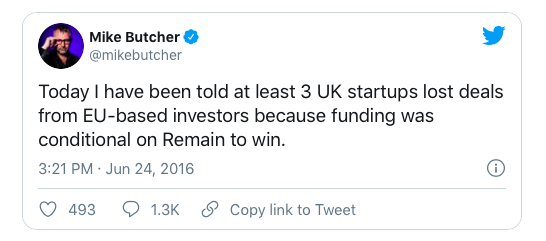
Offices

Word on the grapevine is that many tech are exploring the potential for opening new offices in mainland Europe should the worst happen.

Now that it has, predictions that Google and Amazon will be among the companies that opt to halt investment in office space in London could well make sense.

Berlin or Dublin are likely top of the list for startups, with Frankfurt no doubt eyeing its potential to be Europe’s new, undisputed financial leader.
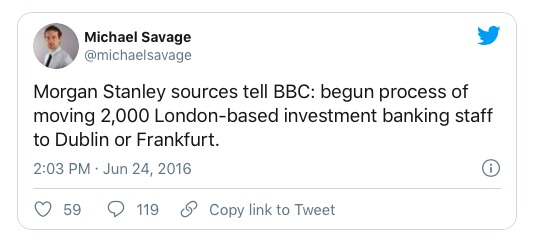
If you’re in need of a quick fix, there’s always Estonia’s e-Residency, which offers the option to remotely set up a legit EU company.

Talent

This could, optimistically, be our big chance to skill up parts of the British workforce that have been left behind in recent years, one of the big contributors to the Leave vote.

But Ronan Dunne, CEO of Telefonica UK, said earlier this month:

“To put that in some context, in order to capitalise on the opportunity promised by the digital economy, UK businesses need an additional 2.3 million digitally skilled workers by 2020 — a tough ask of a Britain on the outside.”

It’s not clear yet if European workers and, indeed students, will have to leave and when but London’s tech sector certainly relies on their work.

The new Mayor Sadiq Khan has sought to reassure his city, just as someone has started a petition to get London out of the UK:

“I want to send a clear message to every European resident living in London – you are very welcome here. As a city, we are grateful for the enormous contribution you make, and that will not change as a result of this referendum.

“There are nearly one million European citizens living in London today, and they bring huge benefits to our city – working hard, paying taxes, working in our public services and contributing to our civic and cultural life.

“We all have a responsibility to now seek to heal the divisions that have emerged throughout this campaign – and to focus on what unites us, rather than that which divides us.”

The European Universities Association, meanwhile, has warnedthat it is “very concerned about the insecurity this causes, notably with regard to the participation of British universities in the EU funding programmes as well as the long-term consequences for European cooperation in research and education”.

The result..?

Although the news of Brexit feels like it took many by surprise, the true fallout after the immediate jolts in the financial markets will take some time to reveal itself.

From a tech perspective, there are many regulations that we’ll almost certainly have to plug back into if we want to continue to trade with our closest neighbours.

There are huge questions about whether we’ll be able to attract the same level of investment and talent if we’re no longer a country that’s welcoming to people from the rest of the world.

A very sad day for many, although, take comfort in the fact we can still compete in Eurovision.

Aside from that, this is only really a great new dawn for Britain’s legal profession.

Where are startups looking for staff… The men’s toilets?

Written as editor of the New Statesman’s NS Tech and first published here.

Yes, like everyone else, I am a bit sick of hearing about the lack of diversity in tech.

But it’s national Women in Engineering Day, don’t you know, and we’re all also sick of Brexit by now, so I thought I’d add a little angry voice to today’s other national party.

What luck, then, that the Mayor’s PR company London & Partners has just released some cringe-inducing stats for London Tech Week that suggest one in every 10 startup companies in London has no women working there. None.

Another half of those asked said that “less than 15 per cent” of their staff could plausibly join the Spice Girls.

Sucks to be outside the M25

There is, of course, no agreed definition on what headcount constitutes a startup – but it’s clear the majority of new companies in our great and diverse capital have between one and a half and zero women on staff.

And that’s from a research piece that suggested “London’s tech community offers the greatest opportunities for British women”.

Where are these people searching for their teams? The men’s toilets?

The survey of 3,700 people conducted by Mortimer Spinks and ComputerWeekly.com found that London employs the most women in tech startups of anywhere in the country. But that really shouldn’t be difficult considering five years of a government-backed effort to promote London’s Tech City.

Rather strangely, the stats hail the news as “progress”, despite there being no comparison with any previous figures.

Not to worry, though. According to related research from Tech London Advocates, almost a third of London tech companies, in a survey of just over 400 members, have “formal initiatives in place to recruit more women to the workforce”.

That’s commitment that’ll have this problem solved quicker than you can say “wait, didn’t Boris travel to Turkey once to invite them into the EU?”.

In the same TLA survey, conducted last month, 21 per cent of these tech companies said they have a female chief executive. Which means the industry looks something like this.

Artist's impression
Artist’s impression

Russ Shaw, founder of Tech London Advocates, makes less of an attempt to defend these rather poor figures, and calls out what is perhaps a “boys’ club” factor.

Guilty secret

But he also calls this problem a “guilty secret”, which is a bit like equating Brexit to a local council by-election.

Like pay discrimination, the lack of diversity of gender, ethnicity and class is an open joke. So is the poor representation of disabled people.

And while we all kind of acknowledge that it’s unfair and actually means your company is going to be less successful, it’d be nice if the whole tech community would put the same energy into diversity as they have into staying in the EU.

Especially since, while the economic predictions around Brexit have sometimes been quite sketchy, it’s pretty universally agreed that having diverse teams makes your company better.

A woman in tech, Janet Matsuda, CMO of flash storage specialist Nimble Storage, told NS Tech:

“The low representation of women in London’s startups is reflective of the wider trends we’re seeing across the engineering and technology industries.

“And with young women making up just 15.8 per cent of undergraduate students studying these subjects, Britain must look at addressing the more fundamental issue of getting more girls interested in STEM careers before it can hope to improve their industry representation.

“Supporting and championing women working in these industries will be essential to dispelling myths that STEM careers are a ‘boys’ club’ and inspiring more young girls to pursue careers in this sector.”

This is an image problem, a pipeline problem, a retention problem and everything in between. It’s also a problem we’ve all known about, for what seems like eternity, and we’re still making little real progress, even after three years of London Technology Week.

The reality is that increasing diversity means the technology industry has to change its culture and look outside the usual crowd. Which is actually inconvenient and uncomfortable, if you stand to ‘lose out’.

We might also have to admit that startups are hard things to do, but they’re significantly less so if your friends and family happen to be seriously wealthy.

For an industry that prides itself on disruption, and solving problems, this is a ridiculously old-fashioned challenge that remains embarrassingly unsolved.

Only 30 government staff work on UK’s corporate data breaches – and 10 other things we learned from the TalkTalk case

Written as editor of the New Statesman’s NS Tech and first published here.

The Culture Media and Sport Committee (CMSC) released a pretty whopping report yesterday prompted by the massive TalkTalk data breach. As it points out, eight months later, we are still awaiting the Information Commissioner’s verdict on the incident.

But, in the meantime, the document paints a reasonably dire picture of where we are right now – while also offering a few recommendations that could change the handling of the UK’s cyber security. Every cloud…

  1. The Information Commissioner received almost 200,000 data protection referrals in the year to March 2015 – there are just 30 staff dealing with those, working on “approximately 1,000 cases at any given time”
  2. The committee has recommended that the Information Commissioner “makes an assessment of resources and priorities as soon as possible” – AKA – get more staff
  3. TalkTalk reported 14 data breaches to the ICO in the two years before the most recent attack – but during that time was kept off the Information Commissioner’s ‘watch list’ of risky businesses
  4. TalkTalk’s CEO Dido Harding said she saw herself as both “accountable and responsible” for security, but the committee said it would be “highly unusual” for the head of a breached company to resign
  5. The committee recommended the rather un-novel idea of allocating responsibility to a chief information officer
  6. It also suggests that “a portion of CEO compensation should be linked to effective cyber security”, instead Harding has just received a £2.8m pay packet
  7. The committee has also recommended a public awareness campaign like that rolled out for smoke alarms, stating that “consumers also have a responsibility to protect themselves”
  8. But it also said it’s “no longer a defence” for companies to say they aren’t aware of the potential for SQL injection or other well-known exploits, with “escalating fines” proposed for poor performance
  9. The committee expressed surprise that there is “no requirement to make security a major consideration in the design of new IT systems and apps”
  10. It suggests that “security by design should be a core principle for new system and apps development and a mandatory part of developer training, with existing development staff retrained as necessary”
  11. The committee itself used both the terms ‘on-line’ and ‘on line’ within its report, which doesn’t give you much faith in its understanding of online threats…

#LDNTechWeek: What on earth has F1 got to do with making toothpaste? McLaren explains

Written as editor of the New Statesman’s NS Tech and first published here.

London Tech Week kicked off this morning, despite the rain, with a short introduction from Ed Vaizey MP, followed by a panel on fashion technology, or fashtech, if you’re in the know.

Digital jumpers aside, one corporate transformation story that really caught our eye was the work that Formula One team McLaren is now doing in the wider technology space.

Of course, its bread and butter is creating the best automotive technology, using the right kind of fuel and building a great team around its F1 hopefuls.

But for the past five years, McLaren has been working with pharmaceuticals giant GSK across both its products and operations, with a view to applying some of its auto-know-how in the big pharma industry.

Specifically, it’s rolled out its rapid 1.8 second wheel change process within GSK’s Maidenhead toothpaste factory, with some pretty interesting results.

“The problem was that they had these high-speed toothpaste filling lines where they were changing over the product five, six, seven times per day,” explained Mike Phillips, head of simulation at McLaren Applied Technologies, to NS Tech.

“But when they changed from one flavour to another, that shut down production line for sometimes upwards of over 30 minutes.

“We started with the tech, adding in sensors to monitor the things we didn’t understand and to find out where failures were happening, but we soon realised much of what we needed to do was about team culture.

“The GSK team on the production line had great ideas, what we had to do was get them working as a team. We used our F1 pitstop processes as an example of a way you plan before your do things, think about things that might go wrong ahead of time and make sure everyone is clear about their responsibilities.”

Phillips explained that McLaren helped GSK more than halve the time it took to turnaround a flavour change, enabling it to produce something like 40 million more tubes of paste in just one factory each year.

“If you try to impose technology into a working culture without thinking about the way that people work, you’re doomed to failure. It’s just an expense.”

McLaren’s Applied Technologies team has now sealed a 10-year partnership with KPMG to deliver technology, data, analytics and simulation projects to large corporates struggling with digital transformation.

Today, that’s focused on consumer goods companies, retail and supply chains, power and utilities, and the financial sector, with a view to helping legacy businesses transform their operational performance.

“A lot of businesses are finding their markets are dynamic like they’ve never been before, but operations are rigid, fixed and high cost, which doesn’t match up,” Phillips said.

“What we’re now delivering with KPMG is dynamic supply chain simulation, using real-time data from the market, plugging in things like marketing campaigns, to allow companies to be dynamic and even predictive about where they’re going to be.”

This is just one piece of the puzzle when it comes to digital transformation, but who’d have thought it’d be one of Britain’s oldest Formula One racing companies that would be driving tech change across UK PLC.

Eric Schmidt thinks getting sued is actually part of Uber’s business strategy

Written as editor of the New Statesman’s NS Tech and first published here.

A quick Google for ‘Uber lawsuit’ reveals just how many pages and pages have been written about the company’s apparent fight for its users against heavy-handed regulators.

“That had to be a component of their business strategy,” Eric Schmidt said of a startup his company is heavily invested induring a chat at Startup Grind in London today.

“Focus on product, focus on product, focus on product,” he advised companies. “You can always deal with the policy issues later as long as you’re following the law.”

Although not exactly a risk-free strategy, he even admitted it “wasn’t until we [Google] had pretty big scale that we had to start to worry a lot about regulation of information”.

Emphasising just how far the company has come, Schmidt highlighted that Gmail now has 1bn individual and enterprise users worldwide, while assuring the crowd: “If you have something that’s secure, you want to keep to yourself, by far the safest place to keep it is Gmail.”

In fairness, despite its size, Google has so far avoided making headlines on getting hacked, although its business model has for a long time relied on monetising the information you share.

Operating under the ‘new startup, happy users’ guise, it can’t go unnoticed that the early avoidance of regulators gives a competitive advantage to new entrants.

And it certainly makes the press squeal.

But 17-year-old Alphabet, once Google, is no longer a spring chicken as we enter our ‘fourth industrial revolution’.

From Google to Alphabet

Alphabet chairman Schmidt knows exactly what it’s like to go through a big restructure.

The 57,000-strong company formerly known as Google is still refining its transformation from a search business with a few bolt-ons, to an alphabetised behemoth of which ads are just one part.

Now operating under the name Alphabet, Schmidt admitted during the chat that the process started by its co-founder Larry Page last year was “announced without deciding all the finer details”.

“The problem with big companies is that they tend to want to do this but they’re also not willing to take the risks of doing so.

“I’d been CEO for a decade, then Larry for four or five years, before he said ‘there’s something wrong with the mission statement, our goals and our structure’.”

The company’s motto, for example, was rather famously ‘don’t be evil’, but that’s been dropped for the company at large in favour of the, perhaps even more relative, ‘do the right thing’.

Are business units just apps?

Schmidt described the challenges faced by big business as simply as being able to identify your different business units as if they were apps on your homescreen.

“It’s very difficult in a large companies to identify those icons and then organise around them. That’s a perpetual problem of any large company.

“… At the end of the day – it’s your product, plus your people – today, the product has to be superb, and global competition is fierce, and the people have to be very good.”

Schmidt doesn’t believe today’s web challenges are much different from the technical quandaries that have come in earlier innovation spurts during his 45 year career.

“You have to understand the power of platforms because they define both the applications, as well as the restraints on what you can build.”

Acknowledging today’s almost unbeatable duopoly of iOS and Android (while noting that the operating system his company built is the largest across the world), Schmidt suggested that, at least in the short term, most new ideas will be powered by one of these, backed by a fast network and open to other products via APIs.

Machine learning in the cloud

Machine learning, not least Google’s own new TensorFlow open source software library, which is very much available for use by competitors, is where Schmidt sees the next wave really blasting off.

“The platform just gets stronger and stronger and that’s what the cloud is about. Cloud computing is a very small component of that [IT] today. It’s 4 per cent, 5 per cent. For the next five to 10 years all of the older systems, the ones that I sold in my previous companies, will get replaced by these cloud systems, and our market share from very low today to much higher.”

He mooted that the next wave of “billion dollar” companies will be those who crowdsource data, which you learn something more from, then sell on in some way.

“This is about building a service [for people] that is better than their knowledge.”

He used this ‘forecast’ as an opportunity to plug the company’s upcoming  AI assistant app Allo, as well as London’s DeepMind AI startup, bought by Google in 2014.

Government criticised for delayed digital skills strategy as 12.6m still lack basics

Written as editor of the New Statesman’s NS Tech and first published here.

A lack of basic skills training for 12.6 million digitally excluded people, SMEs obstructed from hiring international talent by arbitrary visa restrictions, lots of initiatives but no clear strategy.

Those are just three major criticisms made of government in a wide-ranging inquiry into digital skills by the Science and Technology Committee, from school, to the workplace, to those not in work.

The oft-cited ONS stat on people who have never used the internet, while pretty damning at more than 5 million people, masks the fact that a full 23 per cent of the population lack basic skills even if they have used the web.

For businesses, the committee called upskilling a “matter of survival” and, while praising the establishment of the “world-leading” computer curriculum in 2014, highlights that this will “take time to impact the workplace”.

One interesting approach that appeared in the evidence is Birckbeck’s MSc in Data Science that works as a conversion course for people who graduated in other areas.

Samsung recommended “creating a code conversion course to help graduates from non-computer science backgrounds enter the tech sector with a recognised qualification”, but nothing is in place here as yet.

This is certainly not the first critique of our ‘digital skills crisis’, a crisis acknowledged in the report’s title.

On top of the Shadbolt and Wakeham reviews of computer science and STEM degrees, plus the House of Lords Select Committee on Digital Skills report in 2015, and the committee’s own Big Data Dilemma inquiry, there’s an awful lot of paperwork floating around on this issue.

Where’s the government strategy?

The committee’s big hope is that Ed Vaizey’s Digital Strategy, promised soon after the 2015 Spending Review, then again in January, will finally make its way out of DCMS – and that it will actually be of practical use.

In his own evidence to the inquiry, Vaizey admitted that responsibility for ‘digital’ is still spread across the Cabinet Office, BIS and DCMS, no doubt a a recipe for bureaucracy.

He also made clear that the strategy would not have “any particular new funding attached” but that it is “looking at the aspirations for the next 10 years”. Whenever you’re ready.

In the absence of the government’s document, the committee highlights that cyber security, big data, the internet of things, mobile tech and ecommerce skills are key areas that need to be included, particularly with regards to our training of the existing workforce.

The committee has also called on Vaizey to ensure a plan is in place for sharing best practice across large and small businesses, which then goes out into local communities. It also wants visa restrictions for the Tier 2 ‘shortage occupation list’ to be changed so that companies with fewer than 20 staff can also look overseas to fill jobs.

More than just a list of activity

“The MPs question why the government has taken so long to produce the long-promised ‘Digital Strategy’ and call for it to be published without further delay,” the report says.

“The committee warns that the strategy needs to go further than merely listing cross-government digital activity, but present a vision for the future delivered by collaborative work from all involved—industry, educators and Government.”

Indeed, the group of MPs has called on the government to include a transparent “dynamic” map of different initiatives and the money spent on them, in order to match that against the actual economic demand for these skills.

A government spokesman told NS Tech: “This government recognises the crucial role digital skills play in our society and economy.

“Our Digital Strategy, to be published shortly, will set out how we will help employers and individuals access the tools they need to power our digital economy.”

He added:

“This strategy will make sure we are well placed to remain a tech leader in Europe. We will consider the select committee’s report and respond in due course.”

Rachel Neaman, former CEO of government-backed skills provider Go On UK, which recently merged with Martha Lane-Fox’s Doteveryone, has criticised the “complete lack of leadership” on this.

“We have a massive digital skills crisis here in the UK, right from basic skills to advanced digital skills,” Neaman said.

“I’m disappointed, and surprised, that the strategy has taken so long to be created. There are a lot of organisations putting a lot of effort into this – but there needs to be central government leadership, or for the government to pick an organisation to take the lead.”

She added: “This latest report highlights just how big a problem it is – and we have to be clear what we mean and what the problem is that we’re trying to solve.”

Cisco explains why UK businesses are failing (which is a bit awkward)

Written as editor of the New Statesman’s NS Tech and first published here.

Another day, another report that says many businesses have the wrong culture, leadership and skills to do digital transformation.

According to Cisco’s survey of 3,000 workers from UK businesses, almost one in three businesses are still “not bringing in digital technologies”.

Only a quarter of responders were confident in how well the board was doing on this, while 29 per cent said their leaders were struggling to implement new, digitally-powered ways of working.

Speaking to NS Tech, Cisco’s UK CEO Phil Smith, said: “Many companies in the UK don’t have anything other than a very basic website.

“It comes down to skills in some form, whether that’s management, change management, an inability to adapt or be as diligent as they need to be for a rapidly changing world.

“We know there’s a huge gap in productivity but some businesses have decided people just have to work harder, rather than smarter.”

Borrowing from a few big consumer tech ideas, without presumably wanting to scare people, he reckons the sharing economy has something to teach businesses about optimising use of resources, while local 3D printing is the ultimate supply chain killer.

“Two thirds of employees work for companies that are performing below the expected. That’s not all due to digital, but digital has a significant capacity to improve capability.

“If you improve that bottom 75 per cent to match the company that’s 10 percentage points above, that’s £130bn GVA to the UK economy. A big prize if you can get it right.”

A note to the Cisco board

It’s not a bad report and has useful case studies on who’s doing all this well. It just feels a bit like a bit of a long and expensive note to the Cisco board…

Cisco, more particularly its long-time, now-retired CEO John Chambers, has been slated in recent years for not delivering (enough) value for shareholders, given it works across many fast-growth markets.

Its penchant for acquisitions has no doubt given it an interesting org chart, with Chambers once making the news just for having such a complicated management structure.

And getting a new CEO last year, Chuck Robbins, hasn’t rid Cisco of headaches.

The latest is that there’s an internal power struggle against Robbins implementing new ways of working, which has prompted the “legendary” four-person, billion-dollar startup scouting team created under Chambers to resign in protest.

Chambers is, of course, the same man who declared in his outgoing address that 40 per cent of businesses would fail to adapt, and indeed fail, in the next decade.

He may not have been wrong, but could he have been speaking more personally?

On the wider digital transformation story, Cisco UK’s Smith concluded: “There is risk and that’s something you have to manage, not doing something because it is risky is not a reason no to do it.”

Which is probably what Chuck Robbins is thinking right now.

Investigatory Powers Bill passes and your job just got a lot harder

Written as editor of the New Statesman’s NS Tech and first published here.

The controversial Investigatory Powers Bill has been passed by parliament, with 444 MPs voting in favour, including many from the Labour Party, versus just 69 against.

While many in the tech industry have raised concerns about the cost implications and technical challenges of the new powers, this was not enough to persuade lawmakers.

Concessions made in the bill mean that technology companies will not have to build de facto backdoors into encryption software, but judges can demand that firms write software to help them access communications.

Public and private databases will be open to access by the security services, and provisions have been made for the hacking of devices of people who are not direct suspects of a crime.

Internet Service Providers will have to keep databases of things like people’s web and app browsing history, but the government says it will reimburse them for the cost of complying.

Bowing to pressure from the Joint Committee on Human Rights, a review of the bulk collection and retention of data has been ordered and will be conducted by David Anderson QC, an independent reviewer of terrorism laws.

He has already raised concerns about whether the legislation breaches human rights laws.

Jim Killock, executive director of internet rights organisation Open Rights Group, said: “The IP Bill’s powers are too broad and permit the surveillance of citizens whether or not they are suspected of wrongdoing. Surveillance should be targeted at those who are suspected of a crime.”

An internal government report leaked to The Intercept by Ed Snowden this week acknowledges that mass surveillance can even cost lives.

The draft bill now heads to be considered and voted on in the House of Lords, which has recently been unconvinced by a number of government proposals.

So who gets fired when Mark Zuckerberg gets hacked?

Written as editor of the New Statesman’s NS Tech and first published here.

We’ve seen millions of passwords compromised across huge sites like LinkedInMyspace and Tumblr in the last few months. And just this weekend, the London Stock Exchange was hijacked by Anonymous as part of its campaign against large corporations.

Now, in what should raise a loud alarm for people everywhere, the CEO of a company that manages the private lives of more than 1 billion people, Mark Zuckerberg, has apparently fallen victim to hackers.

According to the BBC, the trail likely leads back to the 2012 LinkedIn hack, which continues to resurface every time the hackers are able to decode another lot of passwords.

The first 13 million sets of details leaked had, helpfully to both themselves and the hackers, used the platform’s name to help them remember their password, so they were the easiest targets.

But, using a ‘reverse trapdoor’ or ‘rainbow table’ as it’s called in the trade, hackers can just sit back and use a precomputed program to test out all possible password combinations. With enough time and computing power, it looks like they’ve been able to crack Zuck’s password, which it appears he was using across Twitter and Pinterest too.

“Password sharing is a huge faux pas and a recipe for disaster,” David Shearer, CEO of cyber skills certifier ISC2 tells NS Tech, with a knowing smile.

“Come on, there are password vaults out there! It’s getting increasingly difficult to fight the questions after someone, who appears to be you, has been doing things on your account.”

Those questions must be a million times harder to answer if you’re… Mark Zuckerberg.

Too little, too late from tech cos

This series of hacks is prompting companies across the world to update their security systems.

But changes like those being made by Microsoft, where it updates its list of banned passwords after cross-referencing with the latest haul posted online, or even biometrics like those being trialled at Google, are criticised by the crypto community.

“The main reason Microsoft is getting you to create a ‘really strong password’, is to protect them,” explains Brian Spector, CEO of London-based cryptography startup MIRACL.

“The more complicated the password is, the more time it takes to crack, so they’re just pushing the burden of using their service onto you because they haven’t got anything better.

“Google’s plan doesn’t represent a leap in technology, it’s just something they can do, based on the position they’re in, to mine data on you,” he adds. “It’s not going to fix anybody else’s problems and it likely violates EU privacy regulations. So the jury’s out.”

What companies like MIRACL say they are doing is getting rid of both digital certificates, which have proven to be vulnerable to digital forgery, as well as the need to keep password-based databases ‘somewhere safe’.

Pairing, as it’s called, based on elliptic curves, was just about impossible 15 years ago. But through some very complicated maths, it’s enabling ‘something you have, a key, plus something you know, a PIN’, to arrive online for normal people in a similar way to using an ATM in real life.

“The biggest challenge to the cyber security industry is that there’s now a ubiquity of technology, from smartphones to the Internet of Things, Internet of Everything, smart cities, smart nations, even, and the workforce is just trying to keep up,” says Shearer, whose organisation has certified some 114,000 IT folks around the world.

1.5 million cyber jobs going unfilled

“There are going to be 1.5 million jobs that come available between now and 2020, we have an ageing workforce who are increasingly suffering burnout and we don’t have a wave of young people to replace them,” Shearer warns.

“Ultimately, CEOs get fired for cyber security issues because right now, cyber security staff have no authority within businesses, the reporting lines are unclear and there’s no global standard for how this all works in practice.”

Mark Zuckerberg is unlikely to get fired for something that ultimately doesn’t seem like it was a problem with Facebook’s security, particularly as he’s in charge.

But it’s a rather embarrassing, even dangerous, if the CEO of one of the world’s biggest personal data companies fails Cyber Skills 101. The company’s shareholders will no doubt be asking questions.

Thankfully, our friends over at the New Statesman have prepared a list of nine quick, effective ways to protect your privacy online, which it seems like *some of us, Mark* are still in need of.

GE’s billion-dollar IoT startup – a massive bid to avoid the fate of the telcos

Written as editor of the New Statesman’s NS Tech and first published here.

On the face of it, it’s really not like General Electric, one of the world’s largest companies with interests across huge industries including finance, aircraft engines and healthcare, has anything to worry about.

Indeed, it was one of the founding members listed on the Dow index – and it’s still there – no mean feat after 120 years.

That’s particularly impressive because it’s the only original business that’s still listed there. In fact, as much as sounding like an outstanding success story, that could also make a company feel pretty vulnerable.

GE has a surprisingly diverse portfolio, no doubt one reason it’s staved off business failure where perhaps the now-defunct US Leather Company failed.

However, just as the telecoms providers were sitting pretty 15 years ago with a mobile revolution staring them in the… pipes, OTT utilities are arriving and GE does not want to be the ‘Vodafone of energy’.

Sure we still use telcos, we still need them in many cases, but we don’t want them to come any closer than we need them to.

Current

General Electric took a bit of a punt last year when it announced it’d be putting $1bn into an internal startup, Current, which is focused on using smart technology and data to help huge companies reduce, produce and shift energy use.

Current brings together a number of different GE business units – LED lighting, energy storage, solar, electric charging and analytics software, in the shape of its platform Predix – to help “liberate companies from peak demand usage” and ultimately cuts costs.

Evidence suggests that many consumers aren’t particularly sold on the benefits of the smart home yet, beyond their beloved TV sets, although this is likely to change in the age of smart home metering. But, in the meantime, businesses are finding it increasingly hard to say no to an investment that’ll ultimately help them reduce their overheads.

Where ‘Software as a Service’ took companies like Oracle some time to come around to, ‘Energy as a Service’ is something GE Current is hoping to get its head around quickly enough to keep its century-old brand relevant.

“GE’s aim is to be a digital software company – and a top 10 software company in five to 10 years,” Pete Lau, head of EMEA at GE Current, boldly told NS Tech.

With 330,000 staff worldwide, organisational change must be a mammoth task, but in the “startup atmosphere” created at Current, things are sounding more promising.

“The huge opportunity with the advent of the industrial internet is working out how we connect the digital world to the industrial world. Current is a microcosm for what GE is trying to do, trying to be.”

Staying current

In a post-product age, the cloud-based Predix platform that captures, stores and analyses data from anything connected to the web, is the real killer app for Current.

“We all have to adapt with the times and while there’s always going to be a big market in GE for tangible sales, software complements this offering, letting us provide more services in the future.”

Not only did Current start with $1bn in revenues from the folded-in business units, and has GE’s balance sheet to fall back on, it’s also launched with top-tier global customers.

That’s Walgreens, Simon Property Group, which runs a host of US shopping malls, Hilton Worldwide, JPMorgan Chase, Hospital Corporation of America and Intel.

All of these companies have huge footprints, meaning massive energy usage and legacy systems scattered across the globe.

Current’s pilots have so far tried to help smooth out city traffic flows, and help emergency services attend to gun-related crimes, using LED street lights and noise sensors, respectively. It’s also offering ‘Finance as a Service’ for companies looking to do things like retrofit with LED lighting.

“The moves that GE is making reflect both the opportunity and the imperative to adapt to a market that is changing now more than it has in the last century,” David Kelnar, head of research at London-based venture capital firm MMC Ventures, explains to NS Tech.

He says that utilities’ tech spend between now and 2020 is increasing 2.5 per cent per year, but software spend is increasing by 8 per cent each year – so there’s a lot of money up for grabs.

“One key area is CRM. Digital customer engagement is rising in importance for utilities because they need to close the gap in customer experience versus other consumer-facing industries, meet regulatory requirements and drive their users towards self-service in order to cut costs.

“This is a period of transformational change, where the industry is expanding to include people who generate energy themselves, as well as those who are now managing their energy more actively.

“In the UK, the ‘big six’ too are trying to change from being energy suppliers to providers of a broader range of products and services,” Kelnar adds.

“When your customers and the market are asking for it, what you see is other huge companies trying to get into it, that’s why IoT is becoming a market trend,” Lau agrees.

As well as competitive efforts within its own industry, and from the likes of Samsung and Intel from a slightly different angle, challenges remain around security and interoperability.

“We’re only six months in but we think we’re very well positioned because of our global reach and our resources,” Lau concludes.

That’s about as bold as you can be when you’re a startup backed by GE.